
Blog

Why Choose NBR Seal Kits for Global Buyers?

Global buyers increasingly evaluate sealing components through lifecycle cost, material reliability, and supply continuity. A Nbr Seal Kit addresses these priorities by combining nitrile rubber seals with compatible backup rings, O-rings, and installation components. NBR is widely selected for hydraulic oil, mineral oil, and pneumatic applications because it offers balanced resistance, flexibility, and abrasion performance. It is not a universal solution.

Industry data supports this demand. Grand View Research identifies automotive, industrial machinery, and oil and gas as major application sectors for nitrile butadiene rubber. MarketsandMarkets also highlights transportation and industrial manufacturing as important growth areas for engineered rubber products. However, published market estimates vary because analysts define “NBR” differently. That difference deserves attention.

For international purchasers, the practical question is not simply whether NBR is popular. It is whether the kit matches the operating environment. Temperature, pressure, fluid type, hardness, shaft condition, and storage time can change performance. A seal that works well in a clean hydraulic cylinder may swell in aggressive fuel or fail under excessive heat. Small details matter. For example, a 70 Shore A seal may suit one assembly, while another needs a different hardness and profile.

Experienced suppliers should provide material specifications, dimensional drawings, batch traceability, and test documentation. ISO 3601 is commonly referenced for O-ring dimensions and quality requirements, while ASTM D2000 helps classify rubber performance. These standards improve communication, but they do not replace application testing. That is the uncomfortable part. A lower purchase price can become expensive after leakage, downtime, or field replacement. Choosing an Nbr Seal Kit therefore requires evidence, not attractive claims.
Why Choose NBR Seal Kits for Global Buyers?

What Is an NBR Seal Kit and How Does It Work?

What Is an NBR Seal Kit and How Does It Work?

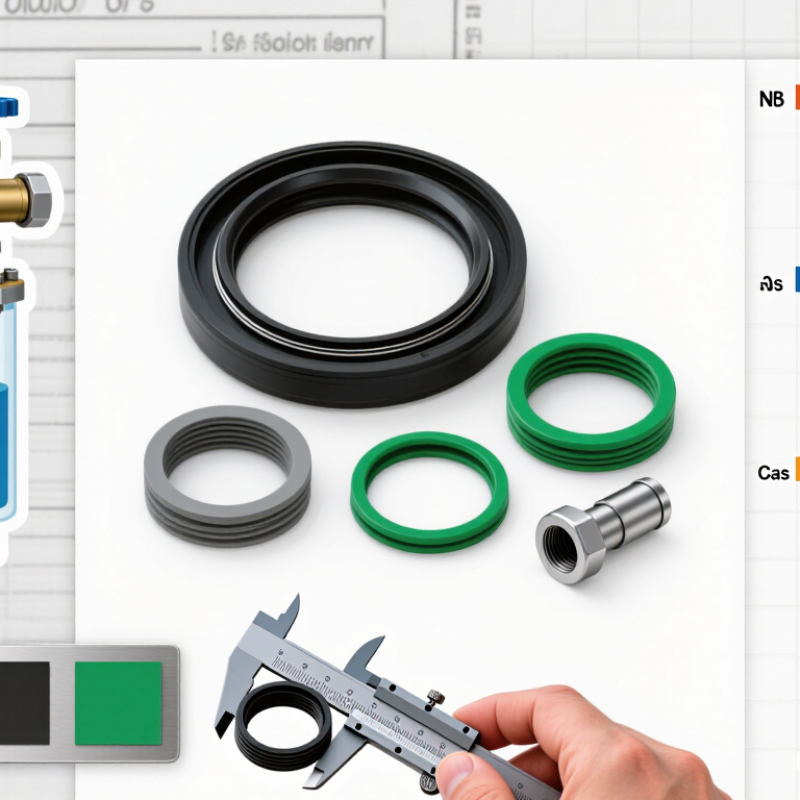
An NBR seal kit contains molded nitrile rubber rings, backup rings, wipers, and sometimes guide elements. These parts sit inside hydraulic or pneumatic equipment. When pressure rises, the NBR seal presses against the rod, piston, or housing wall. This contact blocks oil, fuel, and air from escaping. NBR performs well in petroleum-based fluids and common industrial oils. Typical service temperatures range from about -30°C to 100°C, depending on the compound and design.

According to Grand View Research’s 2024 analysis, the global industrial seals market continues to expand with demand from manufacturing, energy, and mobile machinery. A 2023 report from MarketsandMarkets also identified fluid-power equipment as a major application area for sealing products. These figures explain why global buyers often choose NBR kits for routine maintenance. They are practical, replaceable, and usually cost-efficient. Still, NBR is not universal. Strong ozone exposure, aggressive chemicals, excessive heat, or unsuitable fluids can cause swelling and early cracking. That detail is easy to miss.

Tips: Match the kit with the exact groove size, shaft diameter, pressure, and fluid. Check the material grade, not only the NBR label. Clean the housing carefully before installation. A tiny metal particle can cut a fresh seal. Store unused kits away from sunlight and ozone. Some purchasing decisions look correct on paper, yet field conditions prove otherwise.

Why Is NBR Suitable for Diverse Industrial Sealing Applications?

NBR seal kits suit diverse industrial applications because they handle petroleum-based oils, fuels, and hydraulic fluids reliably. Their resistance comes from acrylonitrile content, which can be adjusted for different operating conditions. Higher acrylonitrile improves oil resistance, while lower content usually supports better flexibility in cold environments. This balance helps NBR seals perform in pumps, cylinders, compressors, and vehicle systems.

The material also offers practical durability under repeated compression and moderate abrasion. In a hydraulic cylinder, for example, an NBR rod seal can face oil pressure, sliding movement, and temperature changes during every operating cycle. Properly designed kits include compatible O-rings, backup rings, and washers, reducing fitting errors during maintenance. Global buyers should request hardness data, dimensional inspection records, and batch traceability before purchase. Small differences matter.

NBR is not perfect. It performs poorly with ozone, sunlight, strong acids, and some aggressive chemicals. That limitation matters in outdoor equipment and chemical processing areas. Operating temperature also depends on the compound, seal design, pressure, and lubricant. A standard grade may fail where a specialized formulation is required. Engineers should check fluid compatibility and groove dimensions instead of choosing by price alone. Testing remains essential, even when previous installations performed well.

What Performance Benefits Do NBR Seal Kits Offer Global Buyers?

NBR seal kits offer global buyers a practical balance of oil resistance, durability, and cost control. In field maintenance, technicians often replace several worn seals during one service visit. A kit with O-rings, wipers, and backup seals can reduce downtime and simplify inventory planning. NBR handles mineral oils, hydraulic fluids, and many lubricants without rapid swelling. This matters in hydraulic cylinders, pumps, valves, and mobile equipment. Less swelling means steadier sealing.

Many standard NBR grades operate from about -30°C to 100°C. Actual limits depend on the compound, pressure, and fluid used. At a cold loading dock, flexible seals can help prevent early leakage. In a dusty workshop, abrasion resistance protects the sealing edge during repeated movement. Good compression resistance also supports reliable performance after long storage. However, NBR is not ideal for every chemical or high-temperature application. That limitation matters.

Experienced buyers should confirm hardness, dimensions, pressure ratings, and fluid compatibility before ordering. I have seen small sizing errors create large maintenance problems. A seal may look correct but fail after heat, pressure, or shaft movement. Checking drawings, samples, and batch records improves purchasing reliability. Clear packaging labels also help technicians identify each part quickly across different locations. Still, installation quality deserves attention. A scratched groove or twisted O-ring can defeat a well-made kit. Perfect results are not automatic.

Why Choose NBR Seal Kits for Global Buyers? - What Performance Benefits Do NBR Seal Kits Offer Global Buyers?

Performance Dimension Typical NBR Seal Kit Data Benefit for Global Buyers Key Selection Consideration Relevant Test or Reference
Oil and Fuel Resistance Good resistance to mineral oils, lubricating oils, hydraulic oils, and many aliphatic fuels. Helps reduce swelling, leakage, and premature replacement in automotive, hydraulic, and general industrial equipment. Select the acrylonitrile content according to the fluid and temperature. Higher acrylonitrile generally improves oil resistance but reduces low-temperature flexibility. ASTM D471 or ISO 1817 fluid-immersion testing.
Recommended Temperature Range Common NBR compounds are typically suitable for approximately −30°C to +100°C; specially formulated grades may extend toward +120°C. Supports use across many temperate and warm operating environments without requiring a high-cost specialty elastomer. Verify continuous and peak temperatures, exposure time, pressure, and fluid compatibility before approval. ASTM D2000 or ISO 1629 compound specification; supplier temperature data.
Hardness Options Commercial NBR seals are commonly available from about 40 to 90 Shore A, with approximately 70 Shore A widely used for general sealing. Allows buyers to match sealing force, extrusion resistance, and installation requirements across different applications. Softer compounds improve conformity; harder compounds generally offer better extrusion resistance at higher pressure. ASTM D2240 or ISO 48-4 Shore hardness testing.
Mechanical Strength Typical molded NBR compounds can provide tensile strength around 10–25 MPa, depending on formulation, hardness, and cure system. Provides reliable resistance to installation damage, pressure cycling, and ordinary mechanical handling. Compare certified batch data rather than relying only on a generic material description. ASTM D412 or ISO 37 tensile testing.
Elasticity and Elongation Typical elongation at break is approximately 150–500%, depending on compound design and hardness. Facilitates installation over shafts, grooves, and mating parts while maintaining contact with sealing surfaces. Use compatible assembly lubricant and control stretch during installation to prevent permanent deformation. ASTM D412 or ISO 37 elongation testing.
Compression Set Resistance Moderate to good compression-set performance is achievable, but results vary significantly with temperature, compound, and exposure duration. Helps maintain sealing force during long service intervals and reduces maintenance frequency. Request compression-set results at the actual operating temperature rather than using room-temperature data alone. ASTM D395 or ISO 815-1.
Abrasion and Wear Resistance Generally good for dynamic sealing applications when the compound, surface finish, lubrication, and pressure are correctly matched. Supports durable performance in hydraulic cylinders, rotating equipment, pumps, and moving joints. Check shaft hardness, surface roughness, speed, pressure, and contamination levels. Application-specific dynamic seal testing; ISO 6194 for rotary shaft seal considerations.
Low-Temperature Flexibility Standard grades commonly operate near −30°C; low-temperature capability depends strongly on acrylonitrile content and formulation. Enables use in many moderate-climate regions and indoor industrial systems. For colder climates or outdoor equipment, confirm low-temperature retraction and flexibility data; another elastomer may be more suitable. ASTM D1329, ASTM D2137, or ISO 812 testing.
Water and Weather Resistance Generally acceptable for limited water exposure, but NBR is not normally the first choice for continuous hot-water, steam, ozone, or outdoor weathering service. Helps buyers identify suitable applications and avoid premature seal failure caused by environmental mismatch. Consider EPDM or another compatible elastomer for continuous hot water, steam, ozone, or severe outdoor exposure. ASTM D1149 ozone testing and ASTM D471 water-immersion testing where applicable.
Dimensional Availability Available in widely used metric and inch-based cross-sections, including O-rings, lip seals, bonded seals, and custom molded profiles. Simplifies sourcing for multinational maintenance teams and reduces the need to redesign existing seal grooves. Confirm size standard, tolerance, cross-section, packaging quantity, and traceability requirements before ordering. ISO 3601 for O-rings; application-specific dimensional drawings and tolerances.
Total Cost of Ownership NBR is generally positioned as a cost-effective general-purpose elastomer with broad oil-service capability. Can lower spare-parts inventory cost and simplify procurement when the operating conditions fall within NBR limits. Evaluate service life, downtime, freight, storage, replacement labor, and failure consequences—not purchase price alone. Use application-specific life testing and documented material traceability.

Note: Values shown are typical engineering ranges for conventional NBR compounds, not guaranteed specifications. Final selection should be based on the actual fluid, temperature, pressure, speed, surface condition, regulatory requirements, and validated test data.

How Should Buyers Evaluate NBR Seal Kit Quality and Compatibility?

Why Choose NBR Seal Kits for Global Buyers?

How Should Buyers Evaluate NBR Seal Kit Quality and Compatibility?

NBR seal kits remain practical for oils, fuels, hydraulic fluids, and general industrial service. The material usually performs well between about -30°C and 100°C, depending on formulation and exposure. Buyers should not judge quality from appearance alone. A smooth black ring can still have poor compression recovery, incorrect hardness, or hidden porosity.

Start with the operating details. Check fluid type, temperature peaks, pressure, shaft speed, groove dimensions, and expected service life. ISO 3601 provides dimensional guidance for many O-rings, while ASTM D2000 helps classify rubber compounds by performance requirements. Ask for compound identification, hardness results, tensile data, and batch traceability. Small details matter.

The U.S. Department of Energy reports that compressed-air leaks can waste 20–30% of compressor output. A weak seal can therefore increase energy loss, downtime, and maintenance costs. For hydraulic applications, request pressure testing under realistic conditions, not only room-temperature inspection. Confirm whether the kit needs backup rings, dust seals, or different hardness grades. Compatibility charts help, but they are not perfect.

I have seen buyers select NBR only because it costs less. That decision can fail when ozone, sunlight, hot water, or aggressive chemicals dominate the application. NBR is useful, not universal. A better evaluation combines laboratory data, installation experience, and clear supplier documentation. When information is missing, pause before ordering.

What Factors Affect NBR Seal Kit Selection, Cost, and Supply?

Why Choose NBR Seal Kits for Global Buyers?

NBR seal kits suit many hydraulic and pneumatic applications because they handle mineral oils, fuels, and moderate temperatures well. Selection should begin with the fluid, pressure, shaft speed, temperature range, and housing design. A seal that fits visually may still fail under heat or swelling. NBR usually performs reliably between approximately -30°C and 100°C, but the exact compound matters. Ozone, sunlight, and aggressive chemicals can reduce service life.

Cost depends on more than rubber weight. Compound quality, hardness, size, tolerances, tooling, inspection, packaging, and order quantity all affect pricing. Custom profiles may require new molds and longer approval cycles. A low unit price can be misleading. It may exclude testing, sorting, or protective packaging. During maintenance reviews, I have seen small dimensional errors create repeated leakage and higher replacement costs. That experience is easy to underestimate.

Tips: Share clear drawings, fluid details, operating temperatures, and annual demand. Ask for material certificates, inspection records, batch traceability, and sample approval. For global supply, confirm production capacity, minimum order quantities, lead times, export packaging, and backup production plans. Keep a small safety stock for critical equipment. It is not perfect, but it reduces exposure to port delays and sudden demand changes. Suppliers should also explain storage limits, because poorly stored NBR can harden before installation.

Why Choose NBR Seal Kits for Global Buyers?

Typical procurement priority scores for selecting NBR seal kits, based on common industrial sealing requirements and international purchasing practices.

NBR is widely selected because it provides strong resistance to mineral oils, hydraulic fluids, fuels, and abrasion at a competitive cost. The material is commonly used within approximately −30°C to +120°C, while actual performance depends on compound formulation, pressure, fluid type, hardness, and seal design. For global buyers, standard dimensions, quality certification, stable raw-material availability, and predictable lead times also strongly affect total procurement value.