What Are the Top Types of Forged Round Rings?
Forged Round Rings serve demanding roles in turbines, pressure vessels, bearings, and heavy machinery. Their circular geometry helps distribute loads, while the forging route can produce a continuous grain flow around the ring. Yet “forged” alone does not guarantee performance. Alloy selection, heat treatment, reduction ratio, and inspection all shape the finished part.
The World Steel Association reported 1,892.2 million tonnes of crude steel production worldwide in 2023. That figure describes the broad steel supply base, not forged-ring output. It helps explain why buyers should examine material traceability and mill documentation alongside dimensions and mechanical properties. A ring destined for a turbine shaft faces different temperature, fatigue, and inspection demands than one used in a general bearing assembly. Small details matter.
This guide compares common types of forged rings, including seamless rolled rings, open-die forged rings, and specialized alloy-steel designs. It will outline where each type fits, what manufacturing choices affect its strength, and which questions help narrow a specification. No source articles or verifiable expert quotation were provided with the request, so I have not attributed a statement to a named industry specialist. A direct quotation should be added only after checking its original publication, wording, and context. That step matters: credible engineering guidance depends on traceable evidence, not polished but unsupported claims.
How Forged Round Rings Are Classified
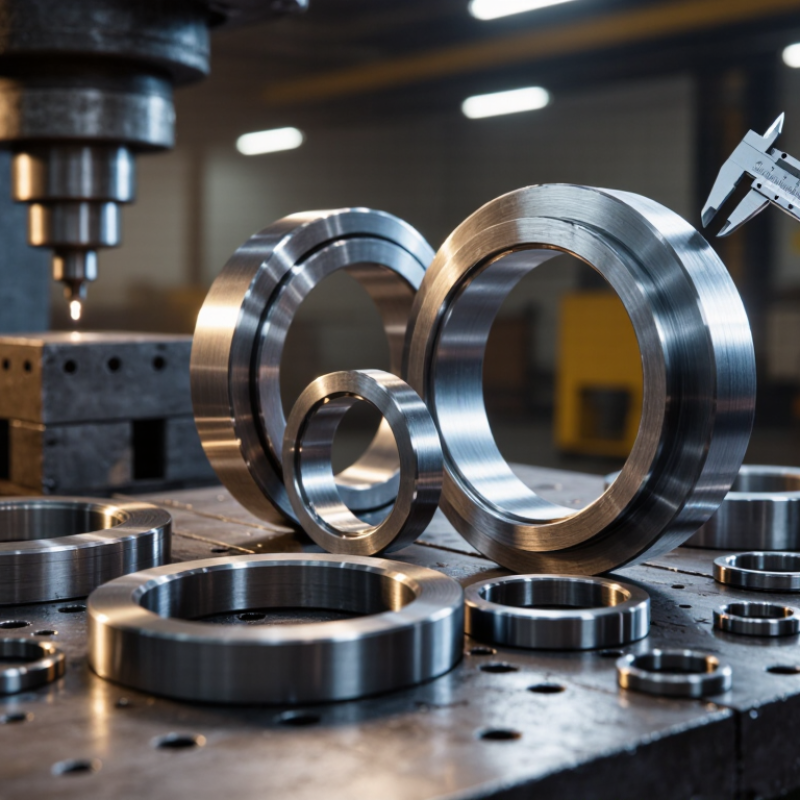
Forged round rings are best classified by how they are made, their shape, and the material they use. Seamless rolled rings begin as heated, pierced billets, then expand between rollers. Open-die forged rings are shaped with repeated press or hammer strokes. Closed-die forging uses shaped tooling to form a more defined outline. The process affects grain flow, dimensions, and the amount of machining required.
Geometry provides another useful category. Rings may have rectangular, stepped, tapered, or contoured cross-sections. Their inner and outer diameters, height, and wall thickness help distinguish one design from another. Material classifications include carbon steel, alloy steel, stainless steel, and certain nonferrous metals. Heat treatment and inspection requirements further define the finished part. The categories can overlap; that is worth remembering when comparing supplier descriptions.
Tips: Check the drawing for material grade, dimensions, tolerances, and heat-treatment requirements. Ask how the ring was formed and what inspection records are available. A polished surface can look reassuring, but it does not prove internal quality. Match the classification to the load, operating temperature, and service conditions. Details matter.
Seamless Rolled Rings: Structure and Key Features
What Are the Top Types of Forged Round Rings?
Seamless Rolled Rings: Structure and Key Features
Seamless rolled rings begin as a heated, pierced metal preform. Rolling forces expand its diameter while shaping the wall and cross-section. The process creates a continuous ring without a welded joint. In many designs, the metal’s grain flow follows the ring’s circumference, which can support strength under suitable loading. Results depend on the alloy, rolling controls, and later heat treatment.
Their geometry can be tailored: faces may be flat, stepped, or profiled, while the bore and outside diameter vary by application. Rings are used in equipment such as turbines, pressure vessels, and heavy machinery. A smooth-looking surface is not proof of sound internal quality. Specifications, dimensional checks, and appropriate nondestructive inspection help verify the finished part. One caveat: “seamless” describes the absence of a weld, not freedom from every possible defect.
Tips: Confirm the material grade, heat-treatment condition, and inspection requirements before ordering. Check wall thickness at several points; small variations can matter. Measurements are easy to rush. Don’t.
What Are the Top Types of Forged Round Rings? - Seamless Rolled Rings: Structure and Key Features
Note: These categories describe forging methods and can overlap in industry usage. Seamless rolled rings are produced by ring rolling; mandrel-expanded rings are commonly made using open-die forging techniques. A welded ring is not a seamless forged ring.
Open-Die Forged Rings: Production and Typical Uses
Open-die forged rings begin as heated billets or blooms. A press or hammer compresses the metal between relatively simple tools, while a mandrel expands the central opening. Repeated passes shape the ring’s diameter and wall thickness. This method suits large or custom components that would be costly to produce with dedicated dies. Scale and tool marks are common before machining. The parts can be massive.
The World Steel Association’s World Steel in Figures 2024 reports global crude-steel production of 1,888.2 million tonnes in 2023. That figure is not ring-production data; it illustrates the scale of the steel supply behind forged components. Typical uses include turbine and generator equipment, pressure-vessel flanges, mining machinery, ship propulsion, and heavy industrial systems. Engineers select the alloy, forging reduction, heat treatment, and inspection plan for each duty. Material flow matters.
Open-die forging offers flexibility, but it is not automatically cheaper or more precise. Large rings may require extensive machining, and thickness variation can complicate assembly. One detail is easy to underestimate. Final performance depends on process records, heat-treatment control, and suitable inspection, not appearance alone. Buyers should specify dimensions, material condition, and acceptance checks before production. This route is useful, but no single forging method fits every application.
Closed-Die Forged Rings: Precision and Applications
Closed-die forged rings are shaped between matched dies that press heated metal into a defined form. The die cavity helps control the ring’s outer profile, inner opening, and overall dimensions. Metal flows under pressure, creating a continuous structure suited to demanding service. The result can require less finish machining than a less controlled forging route. That matters.
These rings are used in equipment such as gear assemblies, pressure systems, and heavy-duty bearings, where strength and consistent geometry are important. A bearing ring, for example, may need a carefully finished raceway after forging; the forging alone does not guarantee final precision. Die wear, billet temperature, and material choice can all affect dimensional consistency. Specifications should therefore account for machining allowance and inspection methods, not just the drawing dimensions. Tight tolerances can increase tooling and production costs. Not every job needs them. A practical design balances fit, load, quantity, and finishing requirements.
How Size, Material, and Service Conditions Guide Ring Selection
Forged round rings are selected by their job: bearing rings need accurate raceways, while flange and gear blanks need suitable geometry and machining allowance. Start with outside diameter, inside diameter, and height, then check fit, load direction, and room for installation. A ring that is too thin can distort under load; oversizing adds weight and machining cost. Still, dimensions alone do not tell the whole story.
Material choice follows the environment. Carbon and alloy steels suit many high-load applications; stainless grades can help where moisture or chemical exposure is a concern. Heat treatment also matters: hardness can improve wear resistance, but may affect toughness and machining. For bearing-ring service, ISO 281:2007 calculates basic rating life using a load exponent of 3 for ball bearings and 10/3 for roller bearings. These are calculation factors, not guaranteed service lives; actual results depend on load, lubrication, cleanliness, and installation.
Tips: Record peak and fluctuating loads, operating temperature, and exposure to water or debris before requesting a ring. Ask for material and heat-treatment traceability, and confirm dimensions after machining. Small details matter. A selection can look right on paper and still need revision after a fit check.

 24 Hour Service