
24 Hour ServiceChoosing a Pvc Steel Wire Hose manufacturer in China takes more than comparing prices. These hoses combine a flexible PVC wall with a steel-wire helix, making them useful for moving water, powders, and other materials in suitable industrial settings. Yet construction and performance can vary between suppliers. A hose that looks sturdy in a product photo may still have the wrong inner diameter, pressure rating, or temperature range for your equipment.
This guide introduces Chinese manufacturers and suppliers and explains what buyers can check before requesting a quotation. Look for clear specifications, including wall thickness, wire spacing, working pressure, and available lengths. Ask how the supplier tests production batches and whether product documents match the exact hose model. A sample can help you inspect flexibility, surface finish, and wire placement. Small details matter. So does the intended use.
Reliable communication is part of the evaluation. A supplier should answer technical questions directly and explain any limits, rather than promise that one hose suits every application. Check production capacity, lead times, packaging, and support for custom dimensions. Where relevant, request quality-management or product test records and confirm their scope with the issuing organization. Do not assume that a certificate covers every model. That assumption is easy to make.
The comparison is not always neat. Product pages may use similar descriptions while specifying different performance values. Use this overview as a starting point, then verify the details with each manufacturer. A careful shortlist can reduce avoidable delays and help match the hose to real operating conditions.
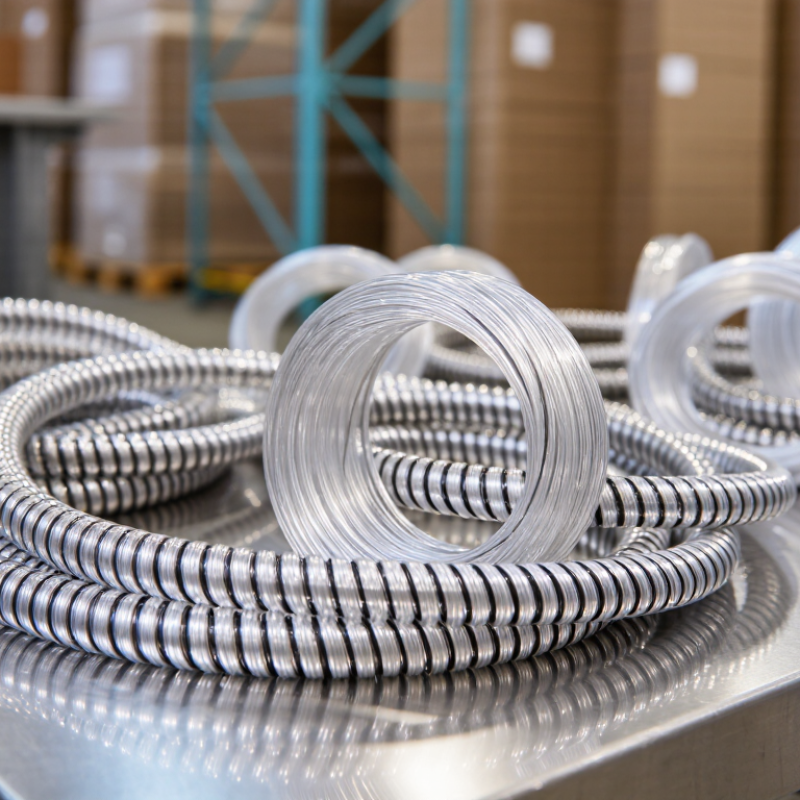
PVC steel wire hoses combine a flexible PVC wall with a spiral steel-wire reinforcement. The wire helps resist collapse under suction and keeps the hose’s shape around bends. A clear or translucent wall can make liquid flow and trapped debris easier to inspect. The reinforcement is not a cure-all. Tight bends may still kink a hose or restrict flow.
Material choice matters. PVC offers low weight and useful resistance to moisture, but performance depends on temperature, pressure, wall thickness, and the conveyed medium. PlasticsEurope’s 2024 report, Plastics—The Fast Facts, estimates global plastics production at 413.8 million tonnes in 2023. That broad figure is not hose-specific, but it shows the scale of the material sector behind products like these. Buyers should check technical data sheets for working pressure, vacuum rating, temperature range, and minimum bend radius.
Look closely at the wire pitch and the hose ends. A poorly matched connector can leak even when the tube itself is well made. Also check whether the stated pressure applies at the intended temperature; PVC can soften in heat. It’s easy to miss. For abrasive or chemically aggressive service, confirm compatibility with the actual fluid rather than relying on a general “PVC” description. A small sample test may reveal issues that a catalogue cannot.
In China, PVC steel wire hose production typically begins with PVC resin and selected additives being blended into a workable compound. The mixture is heated and fed through an extruder to form the inner tube. Its diameter and wall thickness are checked while the material is still warm. Small details matter. A stable tube helps the steel reinforcement sit evenly.
Next, a winding machine places steel wire around the tube in a spiral. The spacing and tension need careful adjustment; uneven winding can affect flexibility and strength. An outer PVC layer is then extruded over the reinforcement, bonding the layers together. Then comes cooling. The hose passes through water baths, is cut to length, and receives visual and dimensional checks.
Some factories also test samples for pressure resistance and layer adhesion. Test conditions should match the intended application. A clean surface alone is not proof of consistent quality, and production records can be imperfect. Buyers can compare samples, specifications, and inspection results before choosing a supplier.
Profiles of leading Chinese PVC steel wire hose manufacturers often differ by production focus. Some concentrate on general-purpose transfer hoses, using clear or colored PVC walls reinforced with a visible steel-wire helix. Others serve industrial buyers who need wider diameters, custom lengths, or tighter control of wall thickness. A practical profile should explain material options, working-temperature limits, pressure ratings, and available inspection records. Details matter. A smooth bore can support flow, while the steel helix helps the hose resist collapse under suction.
Manufacturers with established export operations may provide sample testing, dimensional reports, and packaging tailored for long-distance shipping. Buyers should still confirm how each rating was measured and whether it applies to the requested diameter. A high burst-pressure figure alone can be misleading. Ask about the wire’s spacing, PVC formulation, and performance after repeated bending. These checks reveal more than a broad claim of “heavy duty.” Product pages and sales discussions can be useful, but they do not replace a sample evaluation under realistic operating conditions. Even a careful supplier profile has limits; specifications may not capture every change between production batches.
PVC steel-wire hoses combine a flexible PVC wall with a spiral steel reinforcement. This construction helps resist collapse under suction while allowing a clear view of water or other compatible fluids. Typical uses include drainage, irrigation, and transfer lines in workshops and agricultural settings. Suitability depends on fluid chemistry, temperature, pressure, and bend radius—not appearance alone.
Quality checks should cover inner and outer diameter, wire spacing, flexibility, and connection fit. ISO 1402:2021 describes hydrostatic testing methods for hose assemblies, while ISO 7751:2016 sets application-specific proof and burst pressure ratios. A 2:1 proof-pressure and 4:1 burst-pressure ratio is common in some hose specifications, but it is not a universal guarantee for every PVC steel-wire hose. Ask suppliers for test records tied to the exact hose model. Check for leaks, bulges, and exposed reinforcement after testing. Small defects matter.
Tips: Measure the hose route before ordering; tight bends can flatten the tube and restrict flow. Match the stated working pressure to actual service conditions, including pressure surges. One point worth questioning: a “high-pressure” label means little without a test standard and documented results.
China Top PVC Steel Wire Hose Manufacturers and Suppliers
A reliable Chinese hose supplier should provide more than a low quotation. Ask for a technical data sheet showing working pressure, burst pressure, temperature range, and minimum bend radius. For PVC steel wire hose, inspect the wire’s spacing and whether it remains embedded after bending. Request test records linked to the production batch, not just a generic certificate. PlasticsEurope’s Plastics – the Fast Facts 2023 reported 400.3 million tonnes of global plastics production in 2022. That figure covers plastics broadly, not hose output, but it highlights the scale of material supply and the need to verify a supplier’s actual process controls.
Tips: Ask for a cut sample. Check the wire pitch, wall thickness, and surface finish under bright light. Confirm that sample results match the production specification. Small details matter.
Before placing a large order, request a trial batch and agree on inspection criteria in writing. Check whether the supplier can trace resin and reinforcement materials to each batch, and ask how it handles rejected products. A factory visit or live video inspection can help confirm equipment and testing procedures, though neither guarantees consistent quality. I would also compare lead times against recent delivery records; promised schedules can look perfect on paper. Ask for references from buyers with similar hose sizes and operating conditions.
Use this weighted checklist to compare suppliers without relying on company names. Requirements for PVC steel wire reinforced hose vary by application, size, construction and operating conditions; confirm all specifications for the exact model before ordering.
| Evaluation Area | Weight | What to Check | Evidence to Request | Score |
|---|---|---|---|---|
| Product and application fit | 20% | Confirm the hose is designed for the intended service, such as suction or delivery of compatible liquids. Check nominal inside diameter, length, PVC construction, steel-wire reinforcement, flexibility and any required transparency. | Product data sheet, dimensional drawing and written confirmation of application compatibility. | __/5 |
| Pressure and temperature ratings | 15% | Obtain working pressure, vacuum or suction rating where applicable, burst-test information and operating-temperature limits for the specific diameter and construction. Do not assume ratings are identical across sizes. | Model-specific rating chart and test reports stating test conditions and sample details. | __/5 |
| Material and construction control | 15% | Check PVC formulation and wall construction, steel-wire position and consistency, hose dimensions, and compatibility with the conveyed material. Request disclosure of relevant material changes. | Technical specification, material declaration where available, and agreed product approval sample. | __/5 |
| Quality management | 15% | Review documented inspection procedures for incoming materials, production and finished hoses. Check how nonconforming products, traceability and corrective actions are handled. | Quality-system certificate with valid scope, inspection plan, sample inspection records and traceability example. | __/5 |
| Testing and inspection | 10% | Confirm that dimensional checks and relevant performance tests are performed against agreed requirements. Test methods and acceptance limits should be defined before production. | Recent test records or independent laboratory reports for the relevant product type and specification. | __/5 |
| Production capacity and lead time | 10% | Assess whether the supplier can meet the requested diameter, length, quantity and delivery schedule, including repeat orders and peak-season demand. | Production schedule, stated monthly capacity for the relevant product and written lead-time estimate. | __/5 |
| Customization and packaging | 5% | Clarify available options such as hose length, color, end preparation, labeling and export packaging. Confirm that customized details are recorded in the purchase specification. | Approved specification sheet, packaging details and pre-production sample where needed. | __/5 |
| Export and shipping readiness | 5% | Check experience with the destination market, export documentation, packaging suitability and ability to communicate the agreed shipping terms and delivery schedule. | Sample shipping-document list, packaging photos and a written quotation showing shipment terms. | __/5 |
| Communication and after-sales support | 5% | Evaluate response clarity, technical support, handling of complaints and willingness to document corrective actions. Confirm the contact person and response process before placing an order. | Written response to technical questions, complaint procedure and agreed communication contacts. | __/5 |
| Total | 100% | Weighted result: Add each score out of 5 multiplied by its evaluation weight. | __/5 | |