
 24 Hour Service
- 800.825.3222
- Now Hiring
- Request A Quote
What Are the Top 10 Types of Commercial Lifts?
Commercial Lifts are essential to modern workplaces, retail buildings, hotels, warehouses, and public facilities. They move people, goods, equipment, and sometimes prepared food between floors. A busy shopping centre may need passenger lifts for visitors, while its loading area depends on a robust freight lift. Each application creates different demands.
This guide examines the top 10 types of Commercial Lifts and explains where each one performs best. Passenger lifts support daily building access and smooth visitor movement. Freight lifts handle pallets, machinery, and heavy stock. Service lifts help hotels, hospitals, and restaurants move supplies discreetly. Dumbwaiters carry smaller items, such as dishes, documents, and packaged goods. Platform lifts and stair lifts can improve accessibility when traditional systems are unsuitable.
Other designs include Hydraulic Lifts, traction lifts, scissor lifts, vehicle lifts, and panoramic lifts. Their differences involve capacity, travel height, speed, energy use, installation space, and maintenance requirements. For example, a warehouse may value load strength over appearance. A boutique hotel may prefer quiet operation and attractive finishes.
No single list is perfect. Building layouts, traffic patterns, budgets, and local safety requirements can change the best choice. Real-world experience also matters. A lift that works well in a quiet office may struggle in a busy distribution centre. This overview uses practical considerations and established industry knowledge to compare each type clearly. It also highlights limitations, because reliable lift planning requires more than choosing the most impressive specification. Safety, professional installation, regular inspections, and responsive maintenance should remain central to every decision.
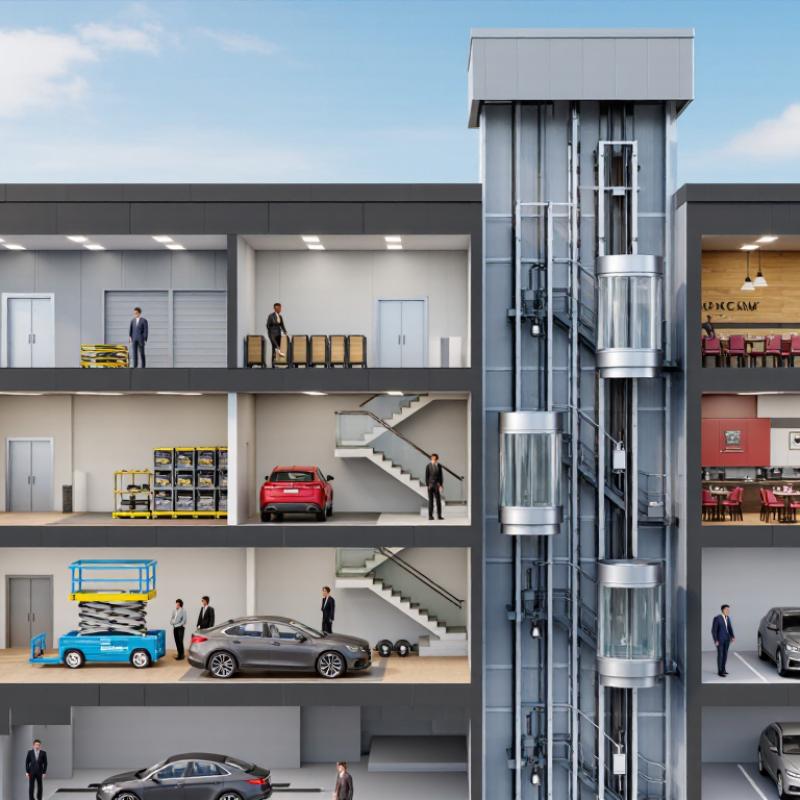
Understanding Commercial Lifts and Their Role in Modern Buildings
What Are the Top 10 Types of Commercial Lifts?
Understanding Commercial Lifts and Their Role in Modern Buildings
Commercial lifts are more than vertical transport equipment. They shape accessibility, safety, logistics, and daily building performance. The ten common types include passenger, freight, service, hospital, dumbwaiter, panoramic, hydraulic, traction, machine-room-less, and vehicle lifts. Each serves a different movement pattern. A hospital lift needs smooth acceleration and wide doors. A freight lift needs reinforced floors and careful loading controls.
On real projects, lift selection begins with traffic analysis, not appearance. Engineers study peak demand, floor heights, waiting times, evacuation planning, and expected load cycles. The Council on Tall Buildings and Urban Habitat identifies vertical transportation as a major planning factor in tall buildings. Poor zoning can create crowded lobbies, even when the equipment itself is technically adequate. That detail is often underestimated.
Energy performance also matters. The International Energy Agency reports that buildings consume about 30% of global final energy. The European Lift Association notes that lifts can use roughly 2% to 10% of a building’s electricity, depending on traffic and equipment. Regenerative drives, efficient lighting, standby controls, and balanced dispatching can reduce waste. However, efficiency figures vary widely between projects. That is the uncomfortable part. A modern lift is not automatically a sustainable lift. Maintenance records, user habits, and realistic traffic data still decide performance.
| No. | Commercial Lift Type | Typical Building Applications | Typical Rated Capacity | Typical Speed Range | Common Drive System | Primary Advantages | Important Planning Considerations |
|---|---|---|---|---|---|---|---|
| 1 | Passenger Lift | Office buildings, hotels, retail centres, apartment buildings and public facilities | 630–2,000 kg 8–26 passengers | 1.0–3.5 m/s | Electric traction; geared or gearless configurations | Efficient everyday movement of people, flexible cabin sizes and broad code availability | Traffic analysis, accessibility, peak-time waiting periods and the number of floors determine the required quantity and capacity |
| 2 | High-Speed Lift | High-rise offices, residential towers, hotels and mixed-use skyscrapers | 1,000–2,500 kg | 3.5–10 m/s | High-performance gearless traction with advanced control systems | Shorter travel times and improved service for buildings with many storeys | Requires careful control of vibration, noise, pressure changes, heat, emergency operation and vertical-transport zoning |
| 3 | Service Lift | Hotels, hospitals, offices, restaurants, schools and retail properties | 1,000–2,500 kg | 0.63–2.5 m/s | Traction or hydraulic drive, depending on building height and duty cycle | Separates deliveries, cleaning equipment and staff movement from public passenger traffic | Cabin finishes should resist impact, moisture and frequent loading; access control may be required |
| 4 | Freight Lift | Warehouses, factories, distribution centres, shopping centres and logistics facilities | 2,000–10,000 kg | 0.25–1.0 m/s | Heavy-duty traction or hydraulic drive | Handles pallets, trolleys, industrial loads and repeated loading cycles | Requires reinforced floors, robust doors, loading-clearance planning, impact protection and suitable ventilation |
| 5 | Hospital or Bed Lift | Hospitals, clinics, care homes and medical research buildings | 1,600–2,500 kg 21–33 passengers | 1.0–2.5 m/s | Electric traction, commonly with smooth-start and smooth-stop controls | Accommodates beds, medical teams, equipment and accompanying visitors in a controlled ride | Cabin dimensions, stretcher clearance, hygiene, emergency power, fire-service operation and infection-control requirements are critical |
| 6 | Machine-Room-Less (MRL) Lift | Commercial offices, hotels, low- to mid-rise buildings and modern refurbishments | 630–2,000 kg | 1.0–2.5 m/s | Compact gearless traction equipment installed within the hoistway | Reduces the need for a separate machine room and can improve building-space efficiency | Maintenance access, heat dissipation, rescue procedures and local code requirements must be addressed during design |
| 7 | Hydraulic Lift | Low-rise commercial buildings, small offices, retail premises and accessible entrances | 450–2,000 kg | 0.15–0.75 m/s | Hydraulic piston and pump system | Suitable for low-rise travel, provides strong lifting force and can offer flexible structural arrangements | Generally has lower speed and higher energy use during upward travel; pit depth, oil equipment and environmental protection require planning |
| 8 | Panoramic or Glass Lift | Shopping centres, hotels, museums, atriums and visitor attractions | 630–1,600 kg | 0.63–2.5 m/s | Traction drive; hydraulic systems may be used for low-rise installations | Provides visibility, supports architectural design and can improve wayfinding in public spaces | Glass safety, glare, solar heat, cleaning access, lighting, privacy and structural integration must be considered |
| 9 | Vertical Platform Lift | Small commercial buildings, public facilities and premises requiring step-free access over limited levels | 225–450 kg | 0.10–0.20 m/s | Screw, hydraulic or electro-mechanical drive | Provides wheelchair and mobility access where a conventional passenger lift may be impractical | Travel height, platform dimensions, guarding, weather protection, landing gates and accessibility regulations affect the design |
| 10 | Dumbwaiter or Small Goods Lift | Restaurants, hotels, libraries, offices, laboratories and retail premises | 50–300 kg | 0.2–1.0 m/s | Electric traction or compact screw-driven mechanism | Moves food, documents, stock and small materials efficiently between floors without using passenger lifts | Load dimensions, fire-rated landing doors, cleaning requirements, interlocks and separation from passenger traffic are important |