
24 Hour ServiceA Copper Brazing Furnace can shape joint consistency, production speed, and operating costs. Yet choosing one is rarely as simple as comparing brochure specifications. Manufacturers differ in furnace design, process controls, available support, and experience with particular component sizes or production volumes. A line brazing compact copper fittings may need a different setup from a plant processing long assemblies in continuous batches.
This guide introduces ten manufacturers serving markets worldwide and outlines the capabilities buyers should examine. Look closely at temperature uniformity, atmosphere control, conveyor or batch configuration, loading access, and maintenance requirements. Ask how suppliers verify process performance and whether they can discuss applications similar to yours. Specific answers matter. So does responsive technical support.
Real production is less tidy than a specification sheet. Part geometry changes, operators need practical access, and output targets can shift. No manufacturer is the right choice for every plant. This comparison is intended as a useful starting point, not a universal verdict. Readers should confirm current product details, service coverage, and suitability directly with each supplier. With those checks in mind, the manufacturers below offer a clearer view of the global furnace market and the factors that can guide a careful purchasing decision.
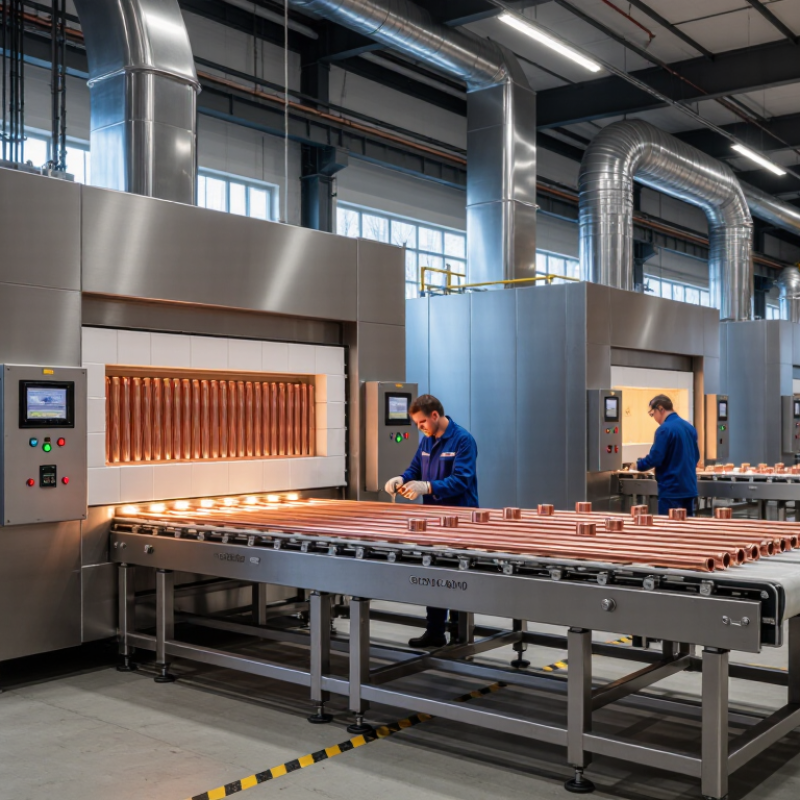
A copper brazing furnace joins parts by heating them until filler metal flows into a narrow joint. The base copper stays solid. AWS A3.0 defines brazing as using filler metal with a liquidus above 450°C, but below the base metals’ solidus. Capillary action draws the molten filler through a clean, closely fitted gap. Small clearances matter.
Copper’s high thermal conductivity makes furnace control important. The Copper Development Association lists copper’s thermal conductivity at about 398 W/m·K at 20°C. Heat can spread quickly from the joint, so uniform heating and a suitable temperature cycle help prevent incomplete flow or excessive oxidation. Depending on the assembly, furnaces use flux or a controlled atmosphere to limit oxide formation. Cleanliness is easy to underestimate.
Common applications include refrigeration coils, heat exchangers, plumbing assemblies, and electrical connections. These parts often need sealed joints or reliable heat transfer. A furnace recipe is not automatically transferable between joint geometries; part mass, gap size, and fixture contact can change the result. Trial runs and inspection still matter.
References: AWS A3.0M/A3.0, Standard Welding Terms and Definitions; Copper Development Association, copper technical data.
When evaluating copper brazing furnace manufacturers, examine process evidence, not brochure claims. Ask for temperature-uniformity maps from a loaded furnace, using your part size and production layout. Empty-chamber readings can hide cold zones near fixtures or doors. Small details matter. Request thermocouple calibration records, atmosphere controls, and repeatability data across multiple production cycles.
Material behavior sets the operating window. NIST reference data give pure copper’s melting point as 1,084.62°C, but brazing temperature depends on the filler metal and joint design. The Copper Development Association’s C11000 data sheet reports electrical conductivity near 100% IACS; copper’s high heat transfer makes stable heating and fixture design especially important. Use AWS C3.6M, Specification for Furnace Brazing, as a technical reference when discussing equipment and process qualification. Ask suppliers to explain how their controls manage ramp rates, atmosphere quality, and temperature variation on your actual assembly. A polished sample run is useful, but it does not prove repeatability. I would also compare maintenance access, spare-part lead times, and energy use per batch; these figures are easy to overlook, and sometimes difficult to compare fairly.
Suggested evaluation weights for comparing suppliers of copper brazing furnaces
These weights are a practical evaluation framework, not measured market data or ratings of individual manufacturers. Adjust them to match your process, production volume, and project requirements.
Profiles of ten leading copper brazing furnace manufacturers worldwide reveal how differently suppliers solve the same production challenge. One may specialize in vacuum systems for clean, intricate assemblies; another may build continuous belt furnaces for high-volume parts. Batch-furnace makers often emphasize flexible loading and recipe control. Some manufacturers focus on compact lines for limited floor space, while others engineer large, integrated systems. There is no universal best choice.
Other profiles highlight atmosphere control, temperature uniformity, and service support. A manufacturer experienced with heat exchangers may understand thin-wall components and joint consistency. One serving electronics production may prioritize repeatable cycles and traceability. Equipment builders with strong controls expertise can simplify process monitoring. Regional manufacturers may offer quicker technical visits, though parts availability still deserves checking. These differences matter on the factory floor. A polished specification sheet cannot prove stable brazing results.
Tips: Ask for sample-run data using your actual copper parts. Check furnace temperature mapping, atmosphere records, and maintenance access. Compare usable production capacity, not just advertised output. One detail is easy to miss: loading patterns can change heating behavior. I would also question any claim of “maintenance-free” operation; real equipment needs inspection, even when well designed.
Note: Company names and brands are omitted. To avoid presenting unverified company-specific claims or rankings, the entries below describe established furnace configuration profiles and the application checks relevant when comparing manufacturers. Actual equipment availability and suitability must be confirmed with each supplier.
| Profile | Furnace configuration | Typical copper-brazing application | Atmosphere or process option | Key specification to verify |
|---|---|---|---|---|
| Profile 01 | Continuous mesh-belt furnace | High-throughput production of small or medium parts that can be conveyed on a belt. | Controlled atmosphere; the gas composition is selected for the material, filler alloy, and joint requirements. | Usable belt width, line speed, temperature uniformity, and atmosphere control. |
| Profile 02 | Continuous pusher furnace | Repeat production of loads arranged in trays or fixtures and advanced through heating zones. | Controlled-atmosphere operation may be specified where oxidation control is required. | Load dimensions, production rate, fixture compatibility, and temperature profile. |
| Profile 03 | Continuous roller-hearth furnace | Parts or fixtures suited to transport on rollers through a continuous heating line. | Atmosphere selection depends on the workpiece, braze alloy, and cleanliness requirements. | Roller material, load limits, transfer arrangement, and temperature uniformity. |
| Profile 04 | Batch vacuum furnace | Batch processing where vacuum processing is appropriate for the part and brazing materials. | Vacuum; process suitability depends on the materials and required joint quality. | Hot-zone dimensions, usable load, vacuum performance, and process repeatability. |
| Profile 05 | Batch retort furnace | Batch loads processed within a sealed retort, including applications needing a controlled process environment. | Retort atmosphere is specified for the particular brazing process. | Retort size, leak integrity, gas flow, and temperature uniformity across the load. |
| Profile 06 | Batch bell-type furnace | Batch processing of components or fixtures that fit within the furnace work zone. | Atmosphere options vary by design and process specification. | Effective work-zone size, loading method, cycle time, and atmosphere management. |
| Profile 07 | Batch pit furnace | Processing of taller loads or assemblies suited to vertical loading. | Process atmosphere, if required, must be confirmed for the specific furnace design. | Maximum load height, lifting and handling provisions, and temperature uniformity. |
| Profile 08 | Continuous conveyor furnace with dedicated fixtures | Production lines where parts require controlled orientation or support during brazing. | Controlled atmosphere may be used where required by the process. | Fixture design, conveyor compatibility, line speed, and part-to-part consistency. |
| Profile 09 | Multi-zone continuous furnace | Processes requiring staged heating, brazing, and cooling along a continuous line. | Atmosphere and zone conditions are specified according to the brazing procedure. | Number and length of zones, achievable ramp profile, cooling arrangement, and control accuracy. |
| Profile 10 | Custom-engineered brazing furnace system | Specialized parts, production layouts, or process requirements that do not fit a standard configuration. | Vacuum or a selected controlled atmosphere, subject to the engineered process design. | Documented process trials, acceptance criteria, automation scope, maintenance access, and service support. |
Process reminder: Brazing temperature and cycle conditions depend on the base materials and filler alloy. The selected cycle must exceed the filler metal’s liquidus temperature while remaining below the base material’s melting temperature, in accordance with the qualified process specification.
A copper brazing furnace should be judged by more than its maximum temperature. Continuous mesh-belt systems suit steady, high-volume production, while batch furnaces offer flexibility for varied parts and smaller runs. Vacuum models can reduce oxidation on sensitive assemblies, but their cycle times and operating costs may not suit every line. Atmosphere-controlled furnaces depend on stable gas flow, accurate dew-point monitoring, and well-sealed doors. Small leaks matter.
Compare usable work-zone dimensions, not just advertised capacity. A furnace may fit a large component but leave too little room for uniform heating. Ask manufacturers for temperature-uniformity data, throughput estimates, energy consumption, and references for similar copper joints. Request a trial using your actual part geometry and filler material. Paper specifications can be optimistic.
Tips: Check belt speed, loading method, cooling arrangements, and maintenance access. Ask how quickly service technicians respond, whether spare parts are stocked, and what training operators receive. Keep a record of joint appearance and leak-test results during trials. One detail is easy to miss: cleaning consistency can affect brazing quality as much as furnace settings. Compare total operating needs, not purchase price alone.
Copper brazing furnace makers are being pushed toward tighter temperature control and lower energy use. The shift is practical: uneven heat can weaken joints, while excess heat wastes energy and may distort thin copper parts. The U.S. Department of Energy’s 2022 Industrial Decarbonization Roadmap says process heating accounts for about 50% of manufacturing energy use. That puts furnace efficiency firmly on the engineering agenda.
Demand adds pressure. The IEA’s Global Critical Minerals Outlook 2024 projects copper demand from clean-energy technologies could grow from roughly 6 million tonnes in 2023 to 10 million tonnes by 2035. For furnace manufacturers, this supports investment in scalable lines, atmosphere control, and repeatable cycle settings. Sensors can track temperature across the load, not just at one point. Useful, but not magic. Poor calibration still produces poor results.
Buyers are also asking about heat recovery, maintenance access, and data logging. These features can help reduce operating costs and trace process variation across batches. Yet a complex control system may create new training needs, especially in smaller plants. That trade-off deserves honest attention. A furnace should match the joint geometry, production volume, and required atmosphere; more automation is not always better.