What is the Thermistor Temperature Formula for Accurate Measurement?
The precision of temperature measurement is paramount across various industries, particularly in electronics and environmental monitoring. The Thermistor Temperature Formula plays a crucial role in achieving such accuracy. Thermistors are temperature-sensitive resistors that exhibit a large change in resistance with a small change in temperature. According to a recent report by ResearchAndMarkets, the global thermistor market is expected to grow steadily, driven by the increasing demand for temperature sensing devices.
To understand the Thermistor Temperature Formula, one must recognize the importance of calibration and environmental factors. Errors can arise from factors like self-heating and thermal lag. The formula itself relies on empirical data, which may vary based on thermistor types and applications. In practice, not all thermistors perform equally, leading to a need for careful selection and testing.
Detailed examination of thermistors reveals that while they offer high sensitivity, they can also introduce complexities. A reliable formula can improve measurement accuracy, but it must be applied with an understanding of the device's limitations. Ultimately, professionals in the field must ensure that their thermistor calibration and application align with established standards. This ensures that users can depend on their measurements, supporting critical operational decisions.
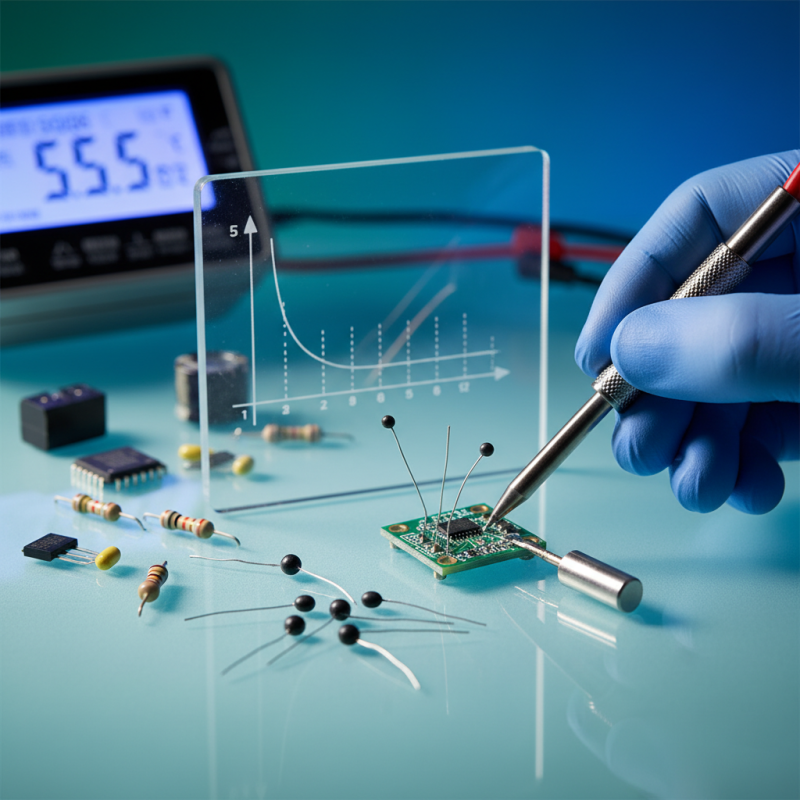
Understanding Thermistors and Their Functionality
Thermistors are temperature-sensitive resistors. They play a crucial role in various applications, from automotive systems to medical devices. Understanding their functionality is essential for accurate temperature measurement. A thermistor's resistance changes significantly with temperature variations, making it a reliable choice for precise temperature readings.
Research shows that thermistors can offer accuracy within ±0.1°C in controlled environments. The NTC (Negative Temperature Coefficient) thermistor decreases resistance as temperature rises. In contrast, PTC (Positive Temperature Coefficient) thermistors exhibit the opposite behavior. These properties allow for intricate designs in temperature-sensing circuits.
However, implementing thermistors isn't without challenges. Factors such as self-heating can skew results, sometimes leading to inaccuracies. Calibration is critical to ensure reliability. The temperature-resistance relationship must be well-documented for each thermistor type. Therefore, knowledge of specific formulas for accurate measurements becomes imperative. Using the correct thermistor can significantly enhance measurement accuracy and overall system performance.
Principles Behind Thermistor Temperature Measurement
Thermistors play a crucial role in temperature measurement. A thermistor is a type of resistor whose resistance varies significantly with temperature. The principles of thermistor temperature measurement are centered around their semiconductor materials, which exhibit a predictable resistance change. This property allows for highly accurate temperature readings, making thermistors essential in various applications, from medical devices to industrial systems.
According to the IEEE, thermistors can achieve temperature accuracy of ±0.1°C. This high level of precision is due to their sensitivity and quick response times. For example, a thermistor with a resistance of 10 kΩ at 25°C may drop to 5 kΩ at 60°C, demonstrating a sizable change for just a modest temperature increase. However, the non-linear relationship between resistance and temperature can be a challenge.
It requires careful calibration and specific formulas, like the Steinhart-Hart equation, to convert resistance readings into accurate temperature values.
While thermistors offer great advantages, they have limitations. Their performance can be affected by environmental conditions and aging. Calibration is essential to maintain accuracy over time. Furthermore, thermistors may not perform well in extreme temperatures, limiting their range in some applications. Users must be aware of these factors for effective thermistor deployment. Accurate measurements depend not only on the thermistor but also on careful implementation and periodic adjustments.
Deriving the Thermistor Temperature Formula
Thermistors are essential for accurate temperature measurements. Understanding how to derive the thermistor temperature formula can significantly improve precision. A thermistor's resistance varies with temperature, often following a nonlinear relationship. The formula typically used is the Steinhart-Hart equation, which incorporates coefficients to model this relationship.
To apply the formula correctly, you need to identify the resistance at different temperatures. This requires data logging and analysis. Using multiple data points can lead to more accurate coefficients for the equation. It's essential to be meticulous when recording the resistance values. Even small errors can lead to significant inaccuracies in the final temperature measurement.
Tips for improving measurements involve ensuring proper calibration. Regular maintenance of the thermistor is crucial. Check connections and clean the sensor regularly. Ensure the environment is stable during measurements. This will help reduce fluctuations caused by external factors. Remember, precision is complex. It's vital to revisit and refine your approach continually.
Thermistor Temperature Measurements
This chart illustrates the relationship between temperature and resistance for a thermistor. As the temperature increases, the resistance decreases, indicating the sensitivity of thermistors in temperature measurement applications.
Factors Affecting Thermistor Accuracy in Measurements
Thermistors are widely used for temperature sensing due to their sensitivity. However, several factors impact their accuracy. The material of the thermistor itself plays a crucial role. Different compositions may yield varying responses to temperature changes. High-quality materials often provide better stability and repeatability.
Additionally, environmental conditions significantly affect thermistor performance. Humidity and dust can interfere with readings. Proper housing is essential to shield against contaminants. This is often overlooked, leading to unreliable data collection.
Temperature gradients within the measurement environment can also skew results. Calibration is another critical aspect of ensuring accuracy. Thermistors must be calibrated regularly to maintain precision. Even slight deviations can cause significant errors in readings.
Users must also consider the measurement range. Using a thermistor outside its specified range can result in poor accuracy. All these factors demonstrate that achieving precise thermistor measurements requires careful attention.
Applications of Thermistor Temperature Measurement in Real-World Scenarios
Thermistors play a crucial role in various applications, particularly in temperature measurement. In healthcare, thermistors are integral to patient monitoring systems. They provide real-time temperature readings with precision. A report from the International Journal of Thermodynamics indicates that thermistors can achieve an accuracy of ±0.1°C, making them ideal for critical applications like neonatal care.
In industrial settings, thermistors are widely used in HVAC systems. These devices help ensure efficient energy consumption. According to the U.S. Department of Energy, precise temperature control can reduce energy use by 10-30% in heating and cooling applications. This is significant for companies aiming to reduce operational costs and carbon footprints. However, these systems must be calibrated regularly to maintain accuracy.
Thermistors are also essential in automotive applications, where they monitor engine temperatures. A temperature deviation can signal issues, preventing costly damage. Studies show that inaccurate readings can lead to performance problems. Accurate data ensures vehicles operate within safety parameters, enhancing reliability and longevity. Achieving this requires continuous attention to maintenance and sensor placement.

 24 Hour Service