
24 Hour ServiceGlobal buyers face a practical question: will a Pallet Conveyor improve flow, or simply move existing problems faster? The answer depends on load weight, pallet dimensions, throughput, safety requirements, and local service capability. MHI’s 2024 Annual Industry Report found that 55% of surveyed supply-chain professionals planned to increase technology and innovation investment. That figure signals strong interest, but it does not guarantee a suitable purchase.
The details matter. A steel pallet carrying 1,000 kilograms behaves differently from a lightweight plastic pallet. Floor unevenness, temperature changes, accumulation pressure, and barcode positioning can affect performance. John Paxton, CEO of MHI, has emphasized that “technology investment must be connected to business strategy.” That principle fits conveyor selection closely. A fast system can still create bottlenecks at picking, wrapping, or truck loading.
Industry research from Interact Analysis also projects continued growth in warehouse automation, driven by labor shortages and e-commerce expectations. Yet reports often describe market direction, not the conditions inside your facility. That gap deserves attention. Buyers should question optimistic payback claims, inspect reference installations, and request test runs using real pallets. Small omissions become expensive later. This guide presents seven practical Pallet Conveyor buying tips for global buyers, covering design, controls, maintenance, supplier evaluation, and total ownership cost. It is not a perfect formula. Each site has exceptions. Careful measurement remains more reliable than impressive brochures.
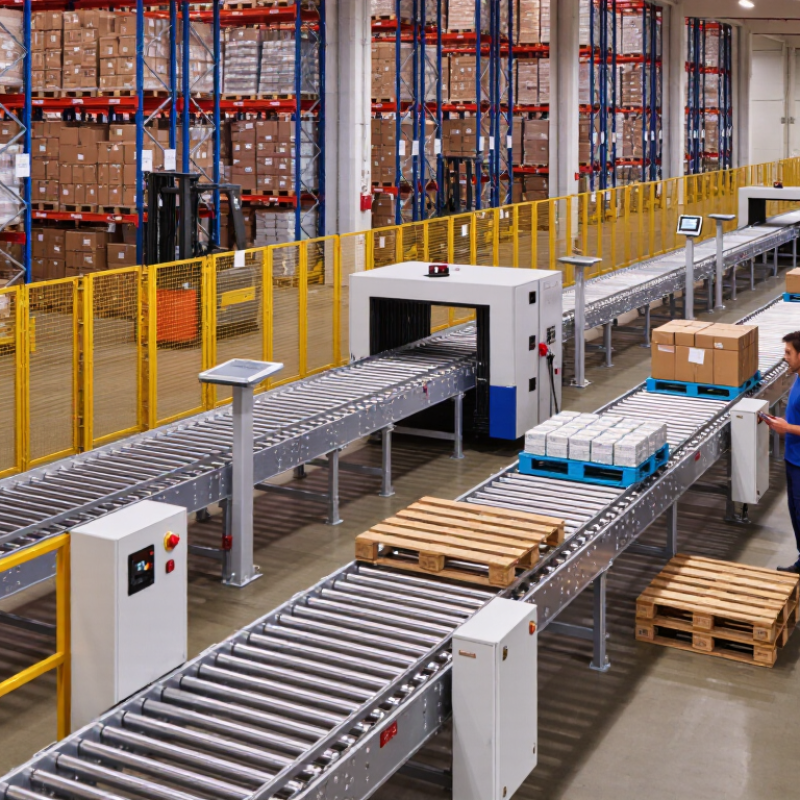
Pallet conveyor selection starts with the load, not the catalog. Measure pallet length, width, weight, and bottom-board spacing. A chain conveyor suits heavy pallets with open bases and fixed transfer points. It offers strong traction. A powered roller conveyor handles varied routes, accumulation, and warehouse staging. Choose rollers with enough contact points to prevent sagging.
Belt conveyors work well with unstable loads or pallets carrying small cartons. They provide continuous support, but damaged pallets can scrape the belt. Turntables and transfers help change direction without large manual handling areas. In packaging lines, these modules connect wrapping, labeling, and inspection stations. In cold or dusty facilities, check seals, lubricant ratings, and frame materials carefully.
Speed is only one buying factor. Ask for the rated load, maximum pallet width, control voltage, emergency-stop layout, and noise level. Leave room for maintenance access. My own early mistake was focusing on motor power while ignoring pallet quality. The conveyor ran well, but broken boards caused repeated stops. A trial with real pallets is wiser. Request drawings, test data, spare-parts availability, and operator training before approval. Global sites may also need different electrical standards and guarding arrangements. Small details matter.
Load capacity is a key factor when selecting a pallet conveyor. Roller and chain conveyors are commonly used for warehouse transport, while transfer units are suitable for heavy-duty positioning and routing. The figures below represent typical engineering design ranges and should be confirmed against pallet dimensions, load distribution, speed, and operating conditions.
Reference unit: kilograms per pallet. Actual specifications vary by conveyor length, roller pitch, pallet condition, duty cycle, and safety requirements.
Assessing the load comes before comparing prices. Record the pallet’s maximum weight, not its average weight. Include uneven loads, damaged boards, and dynamic forces during transfers.
A 1,200 × 1,000 mm pallet carrying 800 kg needs stronger rollers than a lightly loaded export pallet. The conveyor frame, bearings, and drive should support the full design load. I usually allow 15–20% capacity headroom, although this margin should be checked with an engineer. Small errors become expensive quickly.
Pallet dimensions also control conveyor width, roller pitch, and transfer reliability. Measure length, width, height, fork openings, and bottom-board spacing from actual pallets. Do not rely only on shipping documents.
For capacity, convert the required flow into pallets per hour. A line moving 120 pallets hourly needs one pallet every 30 seconds, before stops and accumulation. The 2024 MHI Annual Industry Report reported that 55% of supply-chain professionals expected to increase technology investment.
That supports automation planning, but capacity still depends on physical layout and operating discipline. Keep spare accumulation space.
Check seven points: maximum load, pallet variation, conveyor width, roller pitch, speed, accumulation length, and duty cycle.
ISO 5048 and relevant CEMA guidance can support engineering checks, but local safety requirements still apply. One overlooked issue is moisture. Wet pallets can reduce traction and damage components.
Ask for factory test data under realistic loads. Paper capacity is not enough.
Compare conveyor layouts before comparing prices. A straight line suits stable flows, while L-shaped and U-shaped layouts save space around storage zones.
Tip one: measure aisle width, pallet overhang, columns, and emergency access.
Tip two: separate transport, accumulation, and picking areas.
MHI’s 2024 Annual Industry Report states that 55% of supply chain leaders planned to increase technology investment. That investment fails when the layout ignores future capacity. A simple sketch is not enough.
Tip three: calculate speed from required pallets per hour, not marketing claims.
Tip four: verify load weight, pallet condition, roller spacing, and transfer time.
A fast conveyor can still create a slow system.
Tip five: request accumulation data, including zero-pressure spacing and restart behavior.
Tip six: compare PLC, variable-frequency drive, photoeye, and warehouse-control integration.
Interoperability matters for global sites. The 2024 MHI report also identifies automation as a major supply-chain investment priority, but adoption alone does not guarantee reliable control.
Tip seven: test fault recovery with real pallets.
Ask how operators clear a blocked zone, replace a sensor, and restart safely.
ASME B20.1 provides widely used conveyor safety guidance, yet local requirements may differ.
Do not treat compliance as a paperwork exercise. I have seen impressive speed figures hide poor handoff logic.
Leave room for slower operators, irregular pallets, and imperfect data. That detail often decides whether the system performs beyond the first year.
Global buyers should examine more than load capacity when selecting a pallet conveyor. Safety, maintenance, and energy use affect production costs every day.
Measure the risk first. Check fixed guarding around chains, rollers, and transfer points. Emergency stops should be reachable from normal working positions. Light curtains, presence sensors, and interlocked access doors can prevent unexpected movement. Confirm the conveyor handles the stated pallet weight, dimensions, and speed. Ask for documented testing and installation guidance. Small details matter. A poorly positioned sensor can create repeated stoppages.
Maintenance access deserves equal attention. Inspect whether technicians can reach motors, bearings, belts, and control panels without dismantling nearby equipment. Tool-free covers may reduce service time. Ask about lubrication intervals, wear-part availability, fault codes, and remote diagnostics. In factory audits, I have seen simple cleaning access prevent hours of downtime. However, maintenance claims are sometimes optimistic. Request service records from comparable applications, not only laboratory data.
Energy efficiency depends on operating behavior. Variable-speed drives, efficient motors, zone control, and sleep modes can reduce consumption during idle periods. Accumulation zones should stop when no pallet is present. Measure power at full load and during standby. A smaller motor is not automatically better; undersizing may cause overheating and early failure. Review local voltage, climate, dust, and working hours before approval. Do not guess. Include realistic maintenance labor and energy prices in the ownership calculation.
7 Pallet Conveyor Buying Tips for Global Buyers
Verify the supplier before comparing prices. Request audited quality records, traceability samples, and recent customer references. Ask for a factory acceptance test, not only product photographs. MHI’s 2024 Annual Industry Report found that 55% of respondents planned higher supply-chain technology investment. That investment needs dependable equipment. Check weld quality, roller alignment, controls, guarding, and documented load testing. Small defects become expensive stoppages.
Confirm compliance for every destination market. Request a risk assessment and conformity documents aligned with applicable machinery, electrical, and electromagnetic compatibility requirements. IEC 60204-1 and ISO 13849-1 are useful technical references, but they do not replace local legal review. Verify voltage, plug standards, language requirements, and installation responsibilities. Do not accept a generic certificate. It may cover a different configuration.
Calculate total cost of ownership over five to ten years. Include freight, customs, commissioning, training, energy, lubrication, spare parts, software support, and planned downtime. The World Bank’s Logistics Performance Index 2023 highlights how reliability and shipment timeliness vary significantly across markets. Build local service response into the purchase agreement. Require clear acceptance tests and measurable uptime targets. A low quotation can still be the wrong decision. I have seen buyers overlook conveyor transfers, then pay heavily for redesigns. That mistake deserves reflection. Ask for a five-year parts plan, realistic maintenance intervals, and a written change-control process before signing.
| Buying Tip | Key Dimension | What to Verify with the Supplier | Practical Benchmark or Requirement | TCO Impact | Recommended Buyer Action |
|---|---|---|---|---|---|
| 1Confirm the real load profile | Rated load, pallet size, load distribution, and operating duty | Check both maximum pallet weight and the actual contact points between the pallet and rollers. Confirm whether the load is evenly distributed, overhanging, wrapped, or unstable. | Define the nominal pallet footprint, such as 1,200 × 800 mm or 1,200 × 1,000 mm, and specify the maximum gross load in kilograms. The conveyor should be rated for the heaviest planned load, not the average load. | Correct sizing reduces premature bearing, roller, frame, and drive failures. Oversizing can increase steel, motor, and installation costs. | Provide a written load matrix covering minimum, average, maximum, and abnormal loads. |
| 2Audit supplier quality controls | Manufacturing capability, inspection records, and traceability | Request process controls for frame welding, roller alignment, surface treatment, electrical assembly, final testing, and spare-parts identification. Verify whether inspection results are recorded by serial number or production batch. | A credible quality program should include documented incoming inspection, in-process checks, final functional testing, nonconformance handling, and calibration records for measuring equipment. ISO 9001 certification may support the audit but does not replace product inspection. | Strong process control lowers rework, site installation delays, commissioning costs, and warranty disputes. | Use a pre-shipment inspection checklist with measurable acceptance criteria and photographs. |
| 3Verify global safety compliance | Machine safety, guarding, emergency stops, and electrical conformity | Confirm the intended destination and applicable legal requirements before design approval. Review the risk assessment, safety circuit design, guarding layout, emergency-stop coverage, electrical drawings, and declaration documents. | Common reference points include ISO 12100 for machinery risk assessment, ISO 13849-1 for safety-related control systems, and IEC 60204-1 for electrical equipment of machinery. Market-specific requirements may also apply, including EU or UK conformity obligations and local workplace-safety rules. | Compliance failures can create shipment holds, redesign costs, customs delays, site shutdowns, and legal exposure. | Specify the target country, voltage, frequency, language, documentation, and required conformity route in the purchase contract. |
| 4Match performance to the process | Speed, accumulation, throughput, starts per hour, and control integration | Ask for tested performance at the actual pallet weight and pallet condition. Verify accumulation logic, zero-pressure requirements, transfer timing, sensor response, restart behavior, and interface compatibility with PLC, WMS, or warehouse control systems. | Many pallet conveyor applications operate within approximately 0.1–0.5 m/s, but the correct value depends on pallet stability, transfer distance, spacing, and throughput. Define throughput in pallets per hour rather than relying only on belt or roller speed. | Proper process matching avoids unnecessary motor capacity, excessive energy use, product damage, and bottlenecks at transfers. | Require a throughput calculation and an acceptance test using representative pallets. |
| 5Check environmental suitability | Temperature, humidity, dust, washdown, corrosion, and floor conditions | Confirm enclosure ratings, coating system, stainless or treated components where needed, lubrication requirements, drainage, cable protection, and allowable floor levelness. Verify the operating environment rather than selecting protection based only on price. | Specify the ambient temperature range, relative humidity, dust exposure, cleaning method, and chemical contact. IP ratings describe protection against solid objects and water for electrical enclosures; they do not automatically prove corrosion resistance or suitability for high-pressure washdown. | Correct environmental protection extends service life and reduces corrosion, electrical faults, cleaning downtime, and replacement-part consumption. | Include environmental conditions and cleaning procedures in the technical specification and site survey. |
| 6Calculate total cost of ownership | Purchase price, freight, installation, energy, maintenance, downtime, and replacement parts | Request a cost breakdown for equipment, controls, packaging, export documentation, freight, duties, commissioning, training, recommended spares, and warranty exclusions. Compare energy and maintenance assumptions using the same operating hours. | Use a five-year model: TCO = purchase price + logistics + installation + energy + planned maintenance + corrective maintenance + downtime cost − residual value. Separately identify one-time costs and recurring annual costs. | The lowest quotation may become more expensive when freight, local labor, spare parts, downtime, and compliance work are included. | Compare suppliers with a standardized landed-cost and five-year operating-cost worksheet. |
| 7Secure after-sales support and spares | Warranty, response time, documentation, training, and spare-parts availability | Verify warranty duration and scope, remote-support hours, escalation contacts, troubleshooting procedures, spare-parts lead times, software access, and responsibility for field service. Ensure manuals and drawings are supplied in the required language. | The spare-parts list should identify critical items such as motors, gear units, rollers, sensors, belts or chains, bearings, fuses, safety devices, and control components. Define response and resolution targets in the service agreement. | Accessible support reduces mean time to repair, production losses, emergency freight, and dependence on a single overseas shipment. | Purchase critical spares before commissioning and obtain complete as-built drawings, parameter backups, and maintenance schedules. |
Note: Performance ranges are general planning benchmarks. Final conveyor ratings, safety measures, conformity requirements, and installation specifications must be validated against the actual pallet, process, site, and destination-country regulations.