
24 Hour ServiceChoosing the best Stator tester is not simply a matter of selecting the highest voltage or most expensive model. The right instrument must match your motor types, production volume, test standards, and maintenance goals. A small repair workshop may need a portable tester with clear pass-or-fail results. A manufacturing line may require automated sequencing, data storage, barcode tracking, and integration with existing systems.
Howard W. Penrose, PE, a recognized motor reliability specialist, has stated, “You cannot test quality into a motor; you have to build it in.” His point remains practical. Testing should support good design and workmanship, not disguise weak insulation or poor winding practices. A dependable Stator tester can reveal insulation resistance problems, winding imbalance, turn-to-turn faults, and unexpected leakage. Yet no tester is perfect. Operator training, clean connections, correct test settings, and regular calibration still matter.
Think about the actual work area. Will technicians test a warm motor beside noisy machinery? Will the equipment handle long cables, different frame sizes, and repeated daily tests? These details often matter more than a colorful touchscreen. Safety features deserve close attention, including automatic discharge, guarded terminals, emergency stops, and clear warning signals. Some buyers also overlook software usability. Complicated reports can slow decisions and create avoidable mistakes.
This guide examines the main Stator tester functions, practical selection criteria, and common purchasing errors. It also considers budget limits, measurement accuracy, service support, and future expansion. The best choice is not always the most advanced one. It is the tester your team can use correctly, consistently, and confidently.
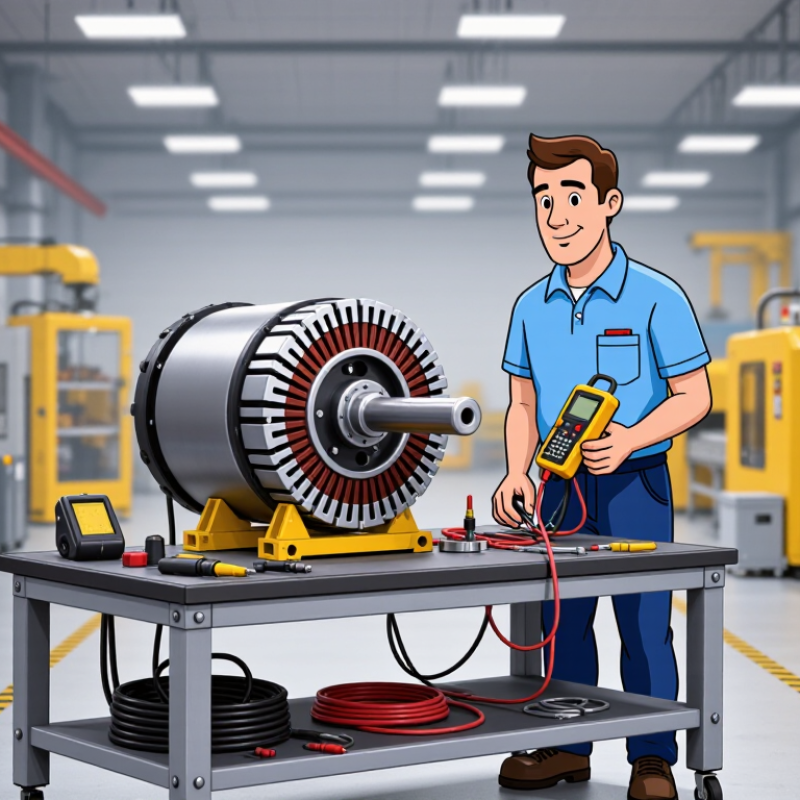
How to Choose the Best Stator Tester for Your Needs?
Understanding What a Stator Tester Measures
A stator tester checks the electrical health of motor windings. It commonly measures resistance between winding phases. Balanced readings usually indicate consistent coil condition. Unequal readings may suggest damaged windings, loose connections, or internal corrosion.
Many testers also perform insulation resistance tests. This measurement identifies unwanted leakage between the windings and the stator core. A weak insulation result can cause overheating or unstable motor performance. Some advanced testers evaluate turn-to-turn faults, inductance, phase balance, and dielectric strength. These measurements reveal problems that a basic multimeter may miss.
In practical workshop testing, I compare readings with the manufacturer’s specifications whenever available. Temperature matters because copper resistance changes as the stator warms. Testing only one phase is not enough. A reliable assessment needs repeated measurements and clean contact points. It is easy to trust one number too quickly. That can be a mistake.
Tips: Choose a tester that matches your motor type and testing environment. Check whether it measures resistance, insulation, and phase balance. Use suitable test leads and inspect terminals before testing. Record readings over time, not just once. A simple log can reveal gradual deterioration. Also, confirm the tester’s accuracy through regular calibration, because even good equipment can drift.
Choosing the best stator tester begins with identifying your actual testing requirements. A repair bench may need resistance, continuity, and insulation checks. A production line usually demands fast, repeatable measurements. If you test high-voltage motor windings, verify the tester’s output range and safety controls carefully.
The stator’s design also matters. Consider winding type, phase arrangement, wire size, and expected operating voltage. Some applications require surge testing to detect weak insulation between turns. Others need temperature compensation because copper resistance changes during testing. Do not confuse more functions with better performance. Small errors matter.
Your working environment should guide the instrument’s form. A maintenance team may value portability and clear screen readings. A factory may need automated sequences, data storage, and communication with production software.
In my experience, simple controls reduce mistakes during repeated inspections. Yet I once focused too much on speed and overlooked report traceability. That choice created extra manual work later.
Ask how results will be verified. Look for calibration records, stable test leads, adjustable limits, and documented safety procedures. The tester should protect both the operator and the winding under test. Training requirements deserve attention, especially when several technicians share one unit. Before purchasing, list your normal tests, unusual faults, expected workload, and acceptable measurement tolerance. A practical trial with real stators can reveal limitations that specifications hide.
How to Choose the Best Stator Tester for Your Needs?
A stator tester should match your winding process, voltage range, and inspection goals. The International Energy Agency estimates that electric motor systems consume about 53% of global electricity. Small insulation defects can therefore create costly efficiency losses and unexpected downtime. The U.S. Department of Energy’s Motor Systems Market Assessment also reports that motor systems use roughly 69% of industrial electricity in the United States. These figures justify careful testing, not guesswork.
Compare surge testing, insulation resistance, high-potential testing, winding resistance, and inductance measurement. Surge testing can reveal turn-to-turn weakness, while resistance testing identifies unbalanced phases. Check measurement accuracy, test voltage stability, automatic discharge, and operator protection. A clear data system matters too. Look for waveform storage, searchable test records, and exportable reports. IEC 60034 testing principles can help define suitable procedures, but field conditions still influence results. A clean workshop test may not represent a hot, contaminated motor. I have found that choosing every available function can increase complexity and training time. More features are not always better.
Tips: Confirm the largest winding voltage first. Check whether the tester supports three-phase comparison. Test lead length matters near large frames. Ask for calibration evidence and service intervals. If production volume is low, a simpler tester may offer better value. If failure analysis is critical, prioritize waveform capture and repeatable test settings. Leave room for human review; automatic pass results can still deserve questions.
Choosing a stator tester starts with accuracy, not a crowded feature list. The U.S. Department of Energy’s Motor Systems Market Assessment notes that motor systems can consume about 70% of industrial electricity. Small testing errors can therefore create expensive maintenance decisions. Look for temperature compensation, lead resistance correction, and calibration traceable to national standards. NIST Technical Note 1297 also stresses measurement uncertainty, not just displayed resolution. A tester showing four decimal places is not automatically accurate. That assumption deserves questioning.
Compatibility is equally practical. Confirm the tester supports the motor’s phase arrangement, voltage range, winding resistance, and insulation requirements. Some units combine resistance, insulation, surge, and hipot testing. Others cover only one method. Check connector types and software communication before purchase. In field work, a technically capable tester can still fail when its leads do not fit the terminal box. IEC 60034 test practices provide useful reference points, but local procedures may differ. Do not copy a laboratory setup blindly.
Tips: Ask for a sample report before buying. Review repeatability at low resistance. Test the interface with gloves. Exported data should include operator, date, temperature, and test limits. The IEA has estimated that motor-driven systems use roughly 46% of global electricity, so reliable records matter. Ease of use is not cosmetic; clear prompts reduce skipped steps. Still, automation is not judgment. A passed test may hide a loose connection, rising temperature, or an unsuitable limit. Review trends, not one reading.
| Tester Type | Typical Measurement Functions | Typical Accuracy | Stator Compatibility | Ease of Use | Best Use Case | Important Limitations |
|---|---|---|---|---|---|---|
| Basic Resistance Tester | Phase-to-phase resistance, winding continuity, open-circuit detection, and resistance imbalance. | About ±0.2% to ±0.5% of reading Accuracy depends on lead compensation, temperature, and measurement range. | Suitable for single-phase and three-phase windings with accessible terminals; works well for low-resistance coils when four-wire measurement is available. | High Simple controls, quick setup, and limited parameter configuration. | Incoming inspection, repair shops, field troubleshooting, and basic winding checks. | Does not reliably identify all turn-to-turn insulation weaknesses or mechanical defects. |
| Handheld Motor Analyzer | Resistance, inductance, phase balance, winding symmetry, and selected insulation checks. | About ±0.1% to ±0.5% of reading Inductance accuracy is affected by test frequency and the magnetic condition of the stator. | Compatible with many low- and medium-power motor stators, provided the phase leads can be isolated. | High Portable display, stored test profiles, and guided test sequences. | Maintenance teams that need portable diagnostics across multiple motor types. | May have limited automation, data export, and high-voltage test capability. |
| LCR-Based Stator Analyzer | Resistance, inductance, capacitance, dissipation factor, impedance, and phase-angle measurements. | Typically ±0.05% to ±0.2% The specified accuracy applies only within the instrument’s stated frequency and impedance range. | Useful for coils and stators whose winding characteristics can be evaluated at controlled AC test frequencies. | Medium Requires correct frequency, level, fixture, and equivalent-circuit settings. | Engineering laboratories, winding development, and comparative quality testing. | Electrical component accuracy does not by itself confirm insulation withstand or mechanical integrity. |
| Surge Comparison Tester | Impulse surge testing, waveform comparison, phase-to-phase comparison, and detection of turn-to-turn insulation faults. | Repeatability is usually more important than a single absolute accuracy value Results depend on pulse voltage, rise time, winding geometry, and reference limits. | Suitable for form-wound and random-wound stators when the test voltage and fixture are appropriate for the insulation system. | Medium Requires trained users to set safe limits and interpret waveform differences. | Production quality control and detection of weaknesses that resistance tests can miss. | High-voltage impulses require guarded fixtures, grounding, interlocks, and documented safety procedures. |
| Insulation Resistance and Hi-Pot Tester | Insulation resistance, dielectric withstand, leakage current, ramp testing, and breakdown detection. | Often specified by voltage accuracy and current-measurement accuracy The exact specification varies with test range, leakage level, and environmental conditions. | Compatible with stators that meet the tester’s voltage, current, capacitance, and connection requirements. | Medium Automated sequences are available, but safety setup and test limits require care. | Verifying insulation systems after winding, repair, varnishing, or assembly. | Can detect insulation problems but cannot replace resistance, surge, or mechanical checks. |
| Automated Production Stator Tester | Combined resistance, inductance, phase balance, insulation resistance, hi-pot, surge, and barcode or recipe control. | Depends on the integrated modules Review the accuracy, repeatability, resolution, and uncertainty for every individual test function. | Best for standardized stators with dedicated fixtures, defined terminal layouts, and repeatable clamping. | High for operators Recipe-based testing, automatic pass/fail decisions, and data logging reduce manual variation. | Medium- and high-volume manufacturing with traceability requirements. | Higher cost, longer setup, and less flexibility when products or winding configurations change frequently. |
| PC-Connected Test System | Multi-parameter electrical testing, programmable limits, statistical process monitoring, database storage, and report generation. | Determined by the installed measurement modules Calibration status and software configuration must be controlled to maintain reliable results. | Flexible when fixtures, adapters, software profiles, and instrument ranges support the required stator designs. | Medium to high Efficient for repeated testing, but initial software setup and training are necessary. | Manufacturing environments that need traceability, audit records, and process-control data. | Requires computer integration, software maintenance, cybersecurity controls, and regular calibration. |
How to Choose the Best Stator Tester for Your Needs?
Cost should be judged beyond the purchase price. A low-cost stator tester may require frequent calibration, replacement probes, or paid software later. Compare testing range, measurement accuracy, warranty length, and expected maintenance. I have seen teams choose cheaper equipment, then lose production time because replacement parts were unavailable. That experience changed my buying checklist.
Safety deserves greater attention than convenience. Look for insulated test leads, controlled voltage output, overload protection, and clear fault indicators. An emergency stop can matter during a rushed inspection. The tester should also include practical instructions for grounding, discharge, and safe handling. Verify relevant compliance documents before purchase. Do not rely only on a sales description. No checklist is perfect.
Support can determine whether the tester becomes useful equipment or expensive storage. Ask how quickly technical questions are answered and whether calibration services are available locally. Good support should include detailed manuals, diagnostic guidance, and training for operators with different skill levels. Request a sample report before ordering. It reveals whether results are easy to interpret. I still prefer testing a unit with real stators, because a clean demonstration may hide awkward cables or confusing menus. A slightly higher price can be reasonable when support prevents repeated errors.
Selecting a tester based on cost, safety, and support
Scores use a practical 1–5 selection framework: cost efficiency reflects the affordability of the equipment, safety reflects features such as insulation, interlocks, and controlled discharge, and support reflects documentation, calibration guidance, training, and service availability. A higher score indicates a stronger fit for that criterion.
Use a basic resistance tester for low-cost routine checks, a portable surge tester when winding fault detection and field mobility are important, and an automated stator analyzer when repeatability, safety controls, and production support are priorities.