
24 Hour ServiceChoosing the right Mccb Circuit Breaker is a practical decision, not a simple catalog exercise. It protects cables, equipment, and people from overloads and short circuits. A suitable model must match the system voltage, continuous load, fault level, and installation environment. In a workshop panel, for example, a 250-amp breaker may appear adequate until motor starting currents cause unwanted trips. Small details matter.
Reliable selection begins with verified technical data. Check the manufacturer’s rated current, breaking capacity, pole arrangement, trip characteristics, and temperature limits. Confirm that the breaker coordinates with upstream and downstream protection. Cable size must also support the selected rating. A breaker with a high current rating cannot compensate for undersized conductors. That mistake can create dangerous heat inside a crowded enclosure.
Real installations often expose gaps in theoretical calculations. Dust, humidity, limited ventilation, and repeated motor starts can change performance. I have seen specifications look correct until the actual panel temperature revealed a derating requirement. Recheck the assumptions. Review the product’s test reports, installation instructions, and applicable electrical standards. A qualified professional should verify the final choice, especially where fault currents are high or continuity is critical. The perfect selection rarely comes from one number. It comes from matching protection, equipment behavior, and real operating conditions. Sometimes, the first choice needs revision. That is not failure; it is responsible engineering.
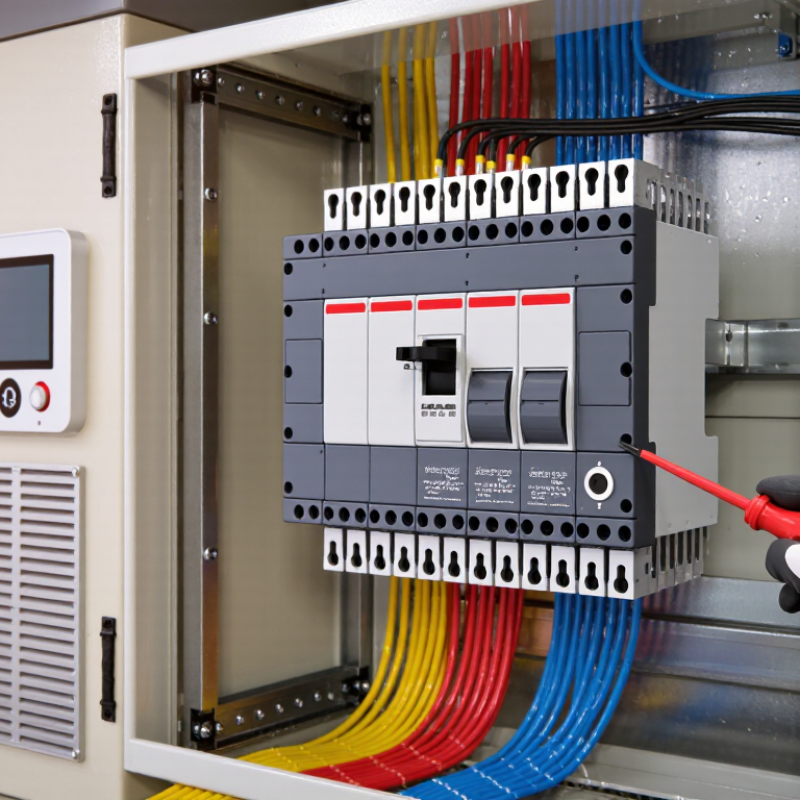
An MCCB protects cables and equipment from overloads and short circuits. Its function sounds simple. The selection is not. Start with the circuit’s normal current, cable ampacity, and expected fault level. The breaker rating must protect the cable, not merely match the equipment label. A higher rating is not automatically safer.
Check the rated voltage, number of poles, and breaking capacity. The breaking capacity must exceed the prospective short-circuit current at the installation point. Adjustable thermal and magnetic settings can improve protection, especially for motors with high starting current. However, incorrect settings may cause nuisance trips or leave cables exposed. That detail is often missed.
Coordination with upstream and downstream devices also matters. Selective tripping can keep a small fault from shutting down an entire panel. Consider ambient temperature, enclosure ventilation, humidity, and available maintenance space. A warm cabinet can affect performance over time. During inspection, look for loose terminals, discoloration, and repeated trip history. These clues may reveal poor connections or an undersized circuit.
Use current electrical standards and the manufacturer’s technical data for final verification. A qualified electrician should confirm installation, torque values, testing, and protection settings. It is tempting to choose by amperage alone. That shortcut deserves reconsideration. Short-circuit conditions, cable length, motor inrush, and future load changes can alter the correct choice.
How to Choose the Right MCCB Circuit Breaker?
Identifying Rated Current, Voltage, and Breaking Capacity
Choosing an MCCB starts with the circuit’s real operating conditions. Rated current must match the protected cable, not only the connected load. For example, a 63 A breaker may suit a 50 A continuous load, if the cable safely supports that rating. Check ambient temperature, installation method, and expected motor starting current. A breaker rated too low may trip repeatedly. One rated too high may leave the cable dangerously unprotected. That basic mistake still appears in hurried equipment schedules.
Voltage selection also needs careful attention. Confirm the system voltage, frequency, number of poles, and the breaker’s rated operational voltage. A three-phase panel may require a different arrangement from a single-phase circuit. Then examine breaking capacity, usually marked as Icu or Ics. This value must exceed the prospective short-circuit current at the installation point. Ask for the fault-level calculation or obtain it from a qualified electrical professional. Nominal supply voltage alone cannot prove suitability. I would recheck this value, especially in industrial panels near transformers.
Tips: Compare the MCCB rating with cable ampacity and measured load data. Leave reasonable room for future expansion, but avoid excessive oversizing. Verify terminal torque, enclosure conditions, and coordination with upstream protection. Keep the calculation record. Small details matter.
Compare rated current with representative ultimate breaking capacity values for low-voltage MCCBs used on 415 V AC systems.
Select a rating at or above the calculated continuous load current, while ensuring the cable ampacity is not exceeded.
The breaker voltage rating must be equal to or higher than the system voltage. The examples shown are based on 415 V AC applications.
Choose an Icu value equal to or higher than the prospective short-circuit current at the installation point.
The chart uses representative IEC 60947-2-based rating combinations commonly found in low-voltage distribution equipment. Actual selections must be verified against the system fault level, installation conditions, coordination requirements, and the applicable product data sheet.
How to Choose the Right MCCB Circuit Breaker?
Selecting an MCCB starts with the load, cable, and expected fault current. Do not choose only by the frame rating. A 250 A frame may require a much lower trip setting. The long-time trip should protect the conductor during sustained overloads. Check the cable’s allowable ampacity, installation method, ambient temperature, and continuous-load duty. NFPA’s Home Structure Fires report estimated that electrical distribution and lighting equipment contributed to about 32,650 home fires annually in 2021–2022. Poor coordination remains a practical concern.
For overload protection, thermal-magnetic MCCBs suit many stable loads. Electronic trips provide finer adjustment and better monitoring. Motors, transformers, and capacitors can create short inrush currents. An instantaneous setting that is too low may cause nuisance tripping during startup. A setting that is too high may delay fault clearing. Use the manufacturer’s time-current curve, not guesswork. IEC 60947-2 requires defined breaking-capacity performance, including Icu and Ics ratings. Select an interrupting rating above the calculated prospective short-circuit current at the installation point.
Short-circuit protection also needs coordination with upstream and downstream devices. Short-time delay can improve selectivity, but it increases energy let-through during a fault. That trade-off deserves calculation. Field experience shows that “maximum” settings are often chosen too quickly. Recheck them after commissioning, especially when motors, generators, or future loads are added. A neat panel is not proof of correct protection. Even experienced engineers can miss cable derating or transformer impedance.
Choosing an MCCB starts with the installation, not the catalog cover. Record the system voltage, operating current, frequency, and prospective short-circuit current. Check the enclosure temperature, humidity, altitude, and available ventilation. Heat can reduce a breaker’s continuous rating. A crowded cabinet may need derating. Do not ignore cable size, terminal space, or mounting direction. I have seen a correctly rated breaker trip because a loose terminal created local heat. Small details matter.
The enclosure should match the site conditions. Dust, moisture, vibration, and restricted access can change the required protection level. Confirm that the breaker fits the panel clearances and allows safe testing. Follow the installation instructions and applicable electrical codes. Torque terminals with a calibrated tool, then record the value. This supports later inspections. It is easy to skip.
Coordination requires more than matching ampere ratings. Compare the MCCB with upstream breakers, fuses, contactors, and downstream protective devices. Check overload curves, instantaneous settings, breaking capacities, and time-current coordination. Selective coordination can keep one feeder energized during a downstream fault. Use verified coordination tables or engineering calculations, not assumptions. Cascading is acceptable only when the tested combination supports it. Review motor starting currents and transformer inrush, too. Otherwise, nuisance trips may appear after commissioning. Recheck the design after field changes. Panels rarely remain exactly as drawn.
Choosing the right MCCB circuit breaker starts with verifying the applicable standards. IEC 60947-2 is widely used for low-voltage circuit breakers, but local electrical codes may add requirements. Check the breaker’s test certificate, rated voltage, frequency, breaking capacity, and enclosure classification. Do not rely on appearance. Certification markings and technical documents matter more.
Safety features should match the installation, not merely the load. Compare the continuous current rating with the calculated demand and cable capacity. Then confirm the short-circuit rating, including Icu and Ics values. Thermal-magnetic protection suits many basic systems, while electronic trip units offer more precise adjustment. Adjustable overload, instantaneous, and earth-fault protection can reduce unnecessary outages. Selective coordination also deserves attention. Otherwise, one fault may shut down an entire distribution section.
Maintenance needs are often underestimated. Keep the MCCB dry, clean, and accessible. Inspect terminals for heat discoloration, loose connections, dust, or unusual odors. Test the trip mechanism according to the manufacturer’s instructions and site risk assessment. Record results instead of trusting memory. In field inspections, a breaker may appear healthy while its connections are overheating. That detail is easy to miss. Maintenance intervals should reflect humidity, dust, vibration, switching frequency, and fault exposure. A fixed yearly schedule may be convenient, but it is not always enough. Have a qualified electrician verify isolation procedures and test equipment before servicing.