
24 Hour ServiceChoosing carbon fiber sheets is not simply a matter of picking the darkest finish or the highest advertised strength. The right sheet depends on what it must do. Will it carry bending loads, resist vibration, or provide a clean surface for a lightweight panel? Those details change the choice. Looks simple. It isn’t.
Composite-structure specialist Dr. Michael C. Y. Niu has written extensively about designing structures with composite materials. A practical takeaway inspired by that work is: “Choose for the load path, not the label.” This is an editorial paraphrase, not a verbatim quotation. It captures a useful point: fiber direction, weave, thickness, resin system, and panel construction all affect performance. A sheet that works well as a flat cover may not suit a part that sees repeated flexing.
This guide explains how to compare carbon fiber sheets by application, construction, finish, and available test data. It also highlights questions worth asking a supplier, such as whether the listed thickness is consistent and whether the sheet is designed for structural use. A glossy surface can look convincing. It cannot prove strength. I would not treat a product description as a substitute for checking specifications against real loads; that can feel less convenient, but it is a sensible place to pause. The goal is a measured choice, not the most impressive-sounding one.
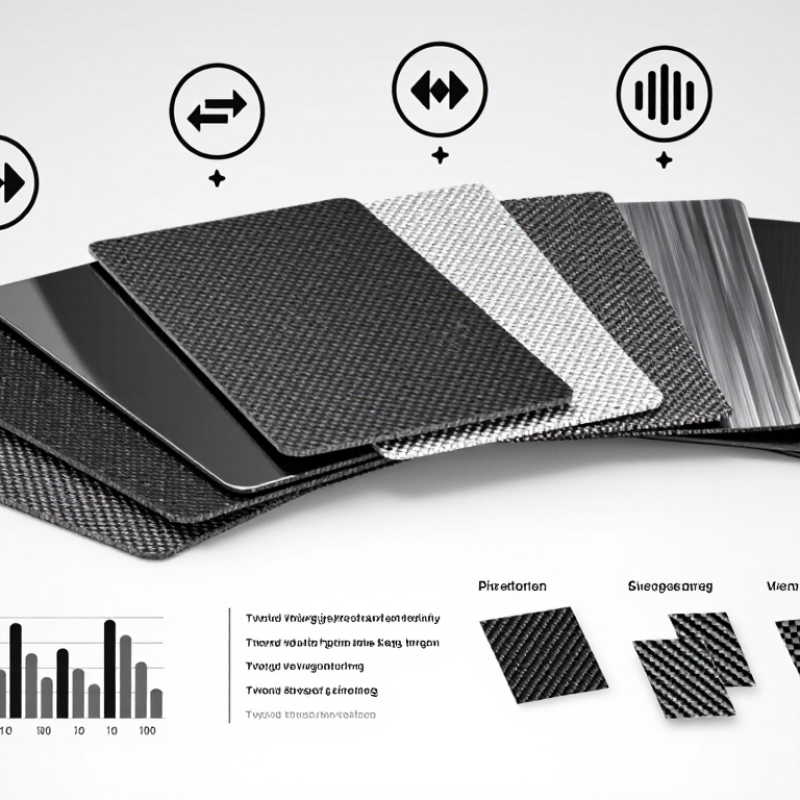
Start with the load. Will the sheet face steady tension, bending, impact, vibration, or repeated cycles? A thin panel may feel rigid in your hand yet flex under a long unsupported span. Record the maximum load, support spacing, acceptable deflection, and direction of the fibers. Strength depends on fiber orientation; a unidirectional sheet performs differently from a woven laminate.
Then define the environment and manufacturing process. Note operating temperature, moisture, UV exposure, chemicals, and contact with metals. Also specify how the sheet will be cut, drilled, bonded, or fastened. Sharp holes and unsupported edges can become weak points. Keep margin. A datasheet alone cannot predict every joint or finished part.
For vehicle applications, weight targets may matter. The U.S. Department of Energy’s “Lightweight Materials for Cars and Trucks” report states that a 10% reduction in vehicle weight can improve fuel economy by 6–8%. Treat this as context, not a guaranteed result from choosing carbon fiber. Compare sheet weight with the complete assembly, including adhesive and fittings. For structural use, request test data for the actual laminate and verify the relevant properties using methods such as ASTM D3039 for tensile testing. A tidy specification can still miss real-world details. Check the cut edges and assembled joints, not just the flat panel.
Choosing carbon fiber sheets starts with the fiber, not the finish. PAN-based fibers suit many general-purpose panels; pitch-based fibers can offer higher stiffness, but may be less forgiving under impact. CMH-17, the Composite Materials Handbook, reports carbon-fiber density around 1.75–1.95 g/cm³, compared with about 7.8 g/cm³ for steel. That weight difference matters for a robot arm or a removable equipment cover. Still, low weight alone does not guarantee a durable part.
Weave changes how a sheet handles loads. Plain weave locks fibers firmly, but its frequent over-under pattern can reduce straight-fiber stiffness. Twill bends more easily around a curved edge and gives a familiar diagonal pattern. Unidirectional sheets place most fibers along one axis, making load direction critical. Check the layup, too: a balanced stack with fibers at 0°, 90°, and ±45° resists more directions than a single-direction panel. A glossy surface can hide a poor choice.
Construction deserves a close look. Solid laminate, foam core, and honeycomb core sheets behave differently near drilled holes and clamped edges. The FAA’s AC 20-107B guidance on composite structures emphasizes evaluating damage and load paths, not just nominal strength. Ask for fiber orientation, resin type, thickness tolerance, and test data. I would still inspect the cut edge; voids or uneven layers can undermine an otherwise convincing sheet.
Choosing a carbon fiber sheet begins with the load it must carry. A thin panel may suit a cover, while a longer unsupported span usually needs more stiffness. Thickness adds rigidity, but also weight and cost. The relationship depends on the laminate, not thickness alone. Check how the fibers are arranged. Direction matters.
Match sheet size to the finished part and its supports. Measure the usable area, then allow room for trimming and mounting holes. A panel that fits on paper may flex between widely spaced fasteners. Small details count. For a flat bracket, note where loads enter and whether edges need support. Cutting can expose fibers, so plan clean edges and suitable finishing.
Compare mechanical data for the actual grade and layup, including tensile strength, flexural properties, and modulus. Tensile strength alone can mislead: a sheet may resist pulling yet perform poorly around a drilled hole or under impact. Ask for test conditions and thickness tolerances, and compare like with like. I still find it easy to overvalue a single impressive number. The application should decide. If loads, temperature, or mounting details are uncertain, test a small sample before committing to a full sheet.
Surface finish, compatibility, and environmental exposure can matter as much as sheet thickness. A glossy surface may suit visible panels, but it does not prove the sheet is stronger or bond-ready. For adhesive joints, check the manufacturer’s surface-treatment guidance and test a small sample with your chosen adhesive. Dust, release agents, and coatings can weaken the bond.
Easy to miss.
Also check whether the sheet’s resin system tolerates your operating temperature and chemicals. A panel near a warm motor may need different specifications from one used indoors.
Compatibility includes the parts touching the sheet. Carbon fiber can promote galvanic corrosion when electrically connected to metals such as aluminum, especially when moisture is present. Use an appropriate insulating layer and consider edge sealing. For outdoor use, ask about UV protection, water exposure, and temperature cycling; do not assume a clear finish provides lasting protection.
A 2011 life-cycle assessment by S. Das in The International Journal of Life Cycle Assessment estimated carbon-fiber production energy at about 183–286 MJ per kilogram, depending on the process. That figure makes service life and material waste worth considering.
Choose a finish and layup that meet the actual job, not just the appearance you want. I would still verify test data for the specific sheet, because published averages cannot predict every resin, finish, or manufacturing batch.
A smooth surface can hide inconsistent resin content or uneven thickness. Check whether the supplier provides a lot-specific certificate, material batch traceability, and measured thickness tolerances. The ASM Handbook, Volume 21: Composites, gives carbon/epoxy laminate densities around 1.5–1.6 g/cm³ as a useful reference range. Treat it as a screening check, not a pass-or-fail rule; fiber type, resin, and layup all affect the result. A clear datasheet should also identify fiber form, weave or layup, resin system, and cure conditions.
Ask how mechanical properties were tested. ASTM D3039/D3039M covers tensile testing of polymer-matrix composite materials, while ASTM D7264/D7264M covers flexural testing. Results are only comparable when test methods, specimen direction, and conditioning are stated. Look for actual test values and sample counts, not just “high strength.” If a supplier provides no test method, ask for clarification. That gap matters.
Tips: Request a recent certificate and a sample panel. Compare its thickness at several points with the stated tolerance. Check for dry spots, waviness, and edge damage under good light. Small differences can be normal, but vague specifications deserve a second look. Don’t assume every sheet in a grade performs identically.
Compare representative material densities as an initial screening reference. Carbon-fiber laminate density varies with fiber, resin, and layup, so confirm the exact value in the supplier’s datasheet.
When reviewing a supplier: request the laminate’s density, thickness tolerance, fiber orientation, and test reports. ASTM D792 covers density; ASTM D3039 covers tensile properties; ASTM D2344 covers short-beam strength; and ASTM D7028 covers glass-transition temperature by DMA. Check that reported results apply to the specific sheet construction you plan to buy.