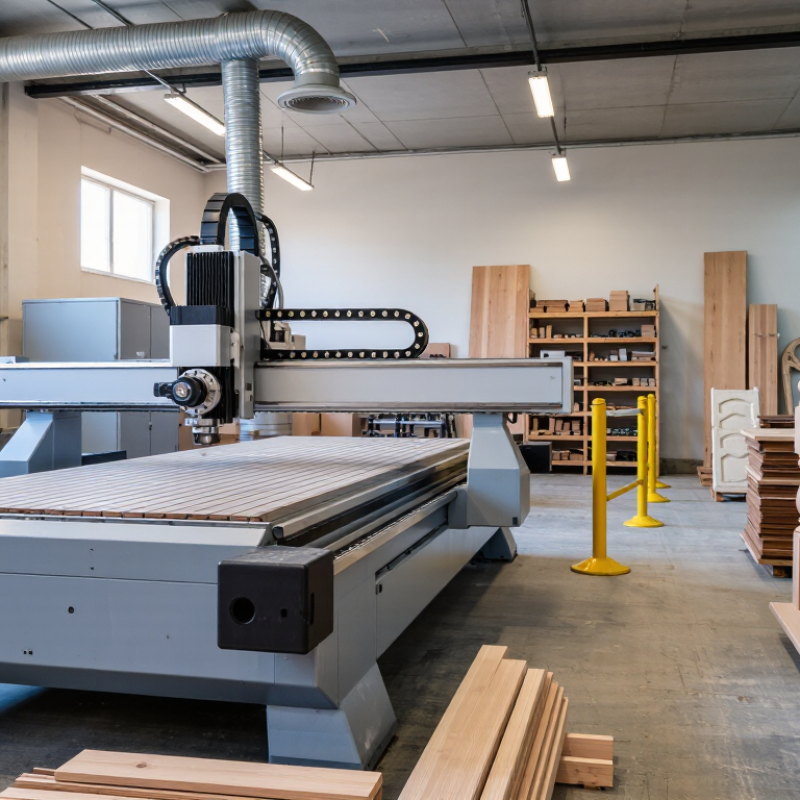
24 Hour ServiceChoosing a 5 Axis Wood Cnc Machine is a practical decision, not merely a comparison of prices and specifications. The right machine should match your materials, workshop space, production volume, and required surface quality. A cabinet maker producing stair parts needs different capabilities from a studio creating carved furniture panels.
Start with the cutting work you actually perform. Confirm the working envelope, spindle power, tool changer capacity, rotary range, and positioning accuracy. Dense hardwoods can expose weak motors and poor dust extraction quickly. A machine may appear powerful on paper, yet struggle with long oak cuts or deep angled pockets. That difference matters.
Software compatibility also deserves careful attention. Verify whether the controller supports your preferred CAD/CAM workflow and post-processors. A capable machine becomes frustrating when toolpaths require constant manual correction. Ask suppliers for sample cuts, tolerance reports, installation details, and customer references. Look closely at the finished edges, not just polished showroom videos.
Safety is part of machine quality. Check guarding, emergency stops, electrical certification, training, and after-sales support. Reliable service can prevent a small spindle fault from becoming a costly production delay. No machine is perfect. Your budget may force compromises. The real question is whether those compromises affect accuracy, uptime, or operator confidence. This guide examines those trade-offs and helps you choose equipment that performs reliably in real woodworking conditions.
Choosing a five-axis wood CNC machine begins with its work envelope. Measure your largest finished panel, not your average project. Include space for clamps, vacuum zones, and safe tool entry. A 1,200-millimeter panel may require more than 1,200 millimeters of travel. Rotary movement can reduce usable space. Check the real cutting range, not only the table dimensions.
Payload matters just as much. Calculate the combined weight of the panel, fixtures, spoilboard, and workholding equipment. Thick hardwood can place serious demands on the table and motion system. Your toolpath also affects machine requirements. Long plunges, deep pockets, and angled cuts need enough clearance around the spindle. A machine may hold the panel but still lack practical tool reach. This is an easy detail to miss. Review sample toolpaths with realistic stock sizes and cutting depths. Ideally, test a smaller section before committing to full production. My first estimate would rarely be perfect.
A 5 axis wood CNC machine needs more than impressive specifications. Spindle speed and power should match your cutters, timber, and production rhythm. An 18,000 RPM spindle often suits larger tools, hardwood trimming, and controlled roughing. It can deliver steadier cutting with less heat when feed rates remain moderate. A 24,000 RPM spindle supports smaller cutters, detailed carving, and cleaner finishing passes. However, higher speed does not automatically produce better surfaces. Excessive RPM can burn wood, shorten tool life, and create fine dust.
Power ratings from 6 to 12 kW also require careful comparison. A 6 kW spindle may handle furniture parts and moderate hardwood work efficiently. A 12 kW unit provides more reserve for deep cuts, large tooling, and continuous production. More power can increase electrical demand and operating costs. It may also encourage aggressive settings before the operator understands the machine. I have seen faster cutting fail because the feed rate was too low. The machine was powerful, but the process was poorly balanced.
Tips: Ask for spindle torque data, not only RPM and kW. Check whether the controller supports your preferred cutting parameters. Test both 18,000 and 24,000 RPM on identical wood samples. Inspect edges, burn marks, vibration, and dust evacuation. Leave room for mistakes. Real workshops rarely match catalog conditions.
How to Choose a 5 Axis Wood CNC Machine?
Verify Accuracy Through ISO 230-2 Positioning and Repeatability Tests
A 5-axis wood CNC machine needs more than a clean showroom cut. Its rotary axes can amplify small positioning errors across curved furniture parts. ISO 230-2:2014 provides a recognized method for testing axis positioning accuracy and repeatability. Ask for the complete test record, not a verbal promise.
The report should show commanded positions, measured positions, bidirectional error, and repeatability values. A laser interferometer or calibrated measurement system should support the results. For example, a 0.02 mm error on a short move may become visible around a tight compound curve. Numbers matter. NIST/SEMATECH statistical guidance distinguishes repeatability from reproducibility. Repeatability measures variation under unchanged conditions. Reproducibility changes operators, temperatures, or setups.
Request tests at several positions across each linear axis. Rotary axes deserve equal attention. Check results after warming the spindle and machine structure. Cold measurements can look impressively stable. They may not represent an eight-hour production shift. ISO 230-2 data also needs context, including temperature, tool condition, fixture design, and measurement uncertainty.
Do not guess.
A practical buyer should compare measured accuracy with the tolerance required for joinery, carving, and panel alignment. Some published figures may describe best-case laboratory performance. That is where careful review matters. Ask for raw data, test direction, calibration dates, and the machine’s condition during testing. A small, repeatable error can often be compensated. Random drift is harder to control.
Choosing a 5 Axis Wood CNC Machine requires more than checking spindle speed or table size. Start with CAM compatibility. Confirm that your software can calculate simultaneous five-axis movements and export a reliable post processor for the controller. Run a sample file with tight curves, angled pockets, and a long tool. Small rotation errors can damage expensive wood.
ATC capacity also deserves careful attention. Count your normal tools, including roughing cutters, finishing tools, drills, and spare lengths. A compact changer may seem efficient, but frequent manual changes interrupt production. Dust control is equally practical. Look for a sealed cutting area, adjustable extraction ports, and airflow strong enough for fine hardwood dust. Inspect hoses and filters during a real cutting test, not only during a showroom demonstration.
Tips: Ask for a complete safety demonstration. Check guarding, emergency stops, interlocks, electrical documentation, and operator training requirements in your region. Confirm that the dust system prevents visible clouds around the table. Test maintenance access, because awkward filter replacement will eventually be ignored. Also review service response and spare-part availability. These details are less exciting, but they affect daily reliability. My cautious view is simple: specifications can look impressive while workflow remains frustrating. Let operators test the machine with representative projects before approval.
Use the comparison below to match machine configuration with workpiece geometry, production volume, tooling requirements, dust-management needs, and workplace safety expectations.
| Machine Configuration | Recommended Work | CAM Compatibility Requirements | Typical ATC Capacity | Dust-Control Arrangement | Safety Features to Verify | Selection Assessment |
|---|---|---|---|---|---|---|
| Compact 5-Axis Router Small-format moving-table or trunnion design | Carved furniture components, prototypes, instrument parts, decorative panels, and short production runs. | Requires a CAM system with simultaneous or indexed 5-axis toolpaths, machine-specific post-processing, tool-length compensation, and collision checking. | 8–12 tools Suitable for basic milling, carving, drilling, and finishing sequences. | Enclosed cutting area with a spindle hood connected to a dust collector. A collection system of approximately 2,000–3,000 m³/h may be suitable for a compact router, subject to duct length and tool size. | Interlocked enclosure or guarded work zone, emergency-stop circuit, spindle braking, overload protection, and clearly marked controls. | Good for flexible prototyping Lower floor-space and tooling requirements, but limited work envelope and production capacity. |
| Production 5-Axis Gantry Router Fixed table with moving gantry | Stair parts, furniture frames, solid-wood components, doors, complex joinery, and repeated batch production. | Confirm support for the controller's kinematic model, rotary-axis limits, tool-center-point control, feed-rate optimization, and verified postprocessor output. | 12–24 tools Practical for multiple roughing, drilling, profiling, and finishing tools without frequent manual changes. | Full-length table extraction, segmented vacuum zones, enclosed spindle hood, and a properly sized dust collector. A planning range of approximately 3,000–6,000 m³/h is common for larger routing areas. | Perimeter guarding, access-door interlocks, emergency stops at operator positions, restart protection after power loss, and documented electrical conformity. | Best general-purpose option Balances work envelope, automation, tooling flexibility, and production throughput. |
| High-Speed 5-Axis CNC with Tilting Head Multi-axis spindle head on a rigid gantry | Deep sculptured surfaces, large furniture parts, molds, architectural elements, and components requiring access from several angles. | CAM must calculate head kinematics, avoid rotary-axis singularities, manage tool-vector changes, and simulate the complete machine including fixtures and the spindle housing. | 16–32 tools Appropriate when machining involves several tool diameters, ball-nose cutters, drills, and dedicated finishing tools. | Close-fitting multi-axis dust shoe, overhead extraction, enclosed work area where practical, and grounded conductive ducting. Extraction performance should be measured at the tool rather than judged only by fan rating. | Interlocked enclosure, safe limited-speed setup mode, axis travel limits, collision protection, emergency-stop monitoring, and controlled access during automatic operation. | Strong for complex geometry Offers excellent tool access, but requires advanced programming, accurate calibration, and experienced operators. |
| Rotary 5-Axis CNC Rotary axis integrated with a flat or indexed table | Columns, legs, posts, balusters, sculptures, turned furniture parts, and four-sided components. | CAM should support rotary-axis wrapping, indexed machining, rotary-axis limits, safe retracts, and a postprocessor matched to the machine's rotary-axis direction and zero position. | 8–16 tools Usually sufficient for rotary roughing, parallel finishing, drilling, and detail cutting. | Rotary dust hood or brush enclosure, extraction near the cutting zone, and clearance around the rotating workpiece. Long workpieces may require additional localized extraction. | Full guarding around the rotary envelope, interlocked access, spindle and rotary-axis emergency stop, overspeed protection where applicable, and secure workholding. | Best for rotational work Highly productive for cylindrical or multi-sided parts, but less convenient for wide flat panels. |
| Heavy-Duty 5-Axis Wood Machining Center Enclosed industrial production cell | High-volume furniture manufacturing, engineered wood components, large solid-wood parts, and continuous multi-shift operation. | Requires tested postprocessors, full machine simulation, automatic tool measurement, work-offset management, probing support, and documented control compatibility. | 24–48+ tools Suitable for large tool libraries, redundant cutters, aggregate heads, drills, and material-specific tooling. | Enclosed extraction with automatic damper control, multiple collection zones, filter monitoring, and a dust collector sized for simultaneous airflow demand. Fine-wood-dust filtration and housekeeping remain essential. | Complete perimeter guarding, interlocked doors, safety-rated control circuits, lockout/tagout provisions, safe setup mode, fault diagnostics, and documented conformity with applicable machinery and electrical requirements. | Best for automated production Highest productivity and repeatability, with greater installation, training, maintenance, and safety-management requirements. |
| Basic Indexed 3+2 Machine Three linear axes with two positioning rotary axes | Angled drilling, fixture-based components, simple compound surfaces, and workpieces that do not require continuous simultaneous 5-axis motion. | CAM must support indexed 3+2 operations, fixture and rotary-axis setup, tool-axis orientation, and safe repositioning between machining planes. | 6–10 tools Adequate for limited operations with occasional manual tool changes. | Standard spindle hood with flexible hose, table extraction, and a dust collector sized for the largest planned cutter and duct run. | Emergency stop, guarded moving axes, spindle protection, restart prevention, secure workholding, and clear setup procedures. | Cost-conscious choice Easier to program than full simultaneous 5-axis machining, but cannot maintain tool orientation continuously around complex surfaces. |