
24 Hour ServiceChoosing a Titanium Welding supplier in 2026 requires more than comparing hourly rates. Titanium can look clean while hidden oxygen contamination weakens the joint. A reliable supplier must control shielding, heat input, joint preparation, and post-weld inspection with documented discipline.
The U.S. Geological Survey’s Mineral Commodity Summaries 2025 continues to identify aerospace, chemical processing, and medical applications as major titanium demand areas. These sectors require traceability, consistent metallurgy, and qualified procedures. The International Titanium Association also highlights titanium’s corrosion resistance and strength-to-weight advantages, which explain its expanding industrial relevance. However, broader titanium growth does not automatically prove welding competence.
John C. Lippold, a respected welding metallurgy specialist, has stated, “Titanium is not difficult to weld, but it is intolerant of contamination.” That sentence should shape every supplier evaluation. Ask whether the company uses dedicated stainless-steel-free tools, high-purity argon, controlled weld chambers, and calibrated oxygen monitoring. Request procedure qualifications, welder certifications, material certificates, inspection records, and representative production samples.
Look closely at the details. A pale silver bead is encouraging. A blue, purple, or gray surface may signal inadequate shielding. The supplier should also explain its compliance with relevant AWS, ASME, or ISO requirements, rather than simply listing certificates on a website.
Cost still matters. It is not the whole decision.
A careful buyer should admit one uncomfortable possibility: an impressive facility can still produce inconsistent welds. Audit the process, not the promises. In 2026, the strongest Titanium Welding partner will combine proven experience, transparent documentation, technical responsiveness, and the humility to investigate its own defects.
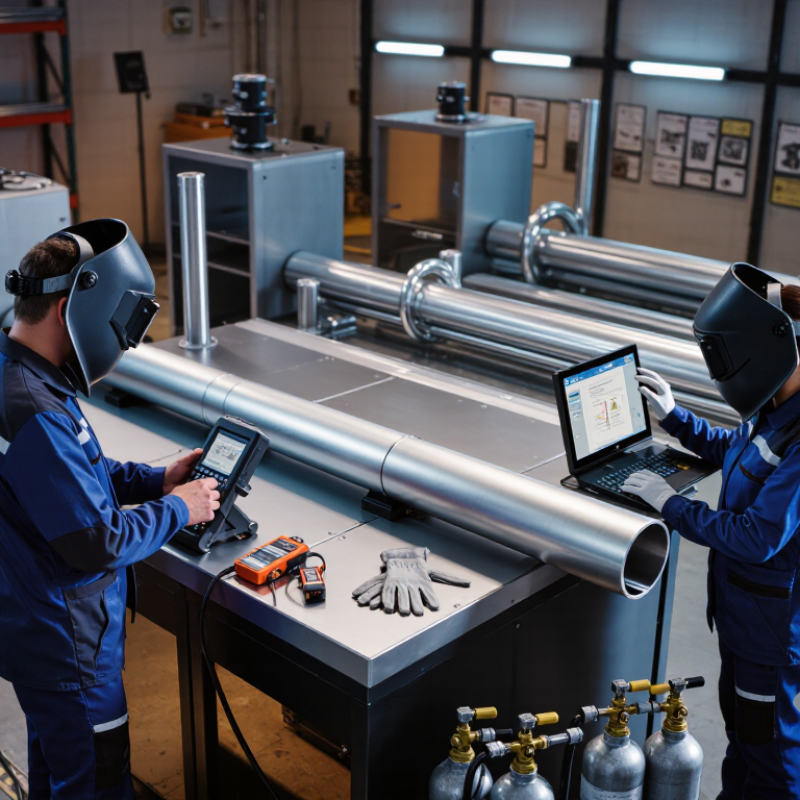
Define your titanium welding requirements before comparing suppliers. State the alloy grade, material thickness, joint design, and expected production volume. A supplier needs more than the phrase “titanium welding.” Grade 2 sheet behaves differently from Grade 5 components during welding. Include drawings, dimensional tolerances, surface-finish limits, and inspection requirements. Mention whether the part will face saltwater, vacuum, heat, vibration, or repeated loading. These conditions influence shielding, heat control, filler selection, and testing methods. Ask for weld procedure qualifications and technician experience with similar applications. Practical experience matters here. A supplier may own advanced equipment but lack useful titanium-specific knowledge.
Application conditions should be written in measurable terms. Give operating temperatures, pressure ranges, exposure time, and cleaning processes. Explain how the finished assembly will be installed and serviced. Small details can prevent expensive misunderstandings. For example, a thin tube near a heat-sensitive seal may require tighter heat input control. Do not assume a standard procedure will fit your design. That assumption can fail. Some requirements may also remain uncertain during early development. Record those gaps and ask the supplier how they will manage them. Their response can reveal technical honesty and engineering depth.
Tips: Request sample weld records, inspection reports, and traceability documents. Confirm oxygen monitoring, purge-gas controls, and post-weld cleaning practices. Ask how defects are recorded and corrected. Compare answers, not only prices. A clear supplier should explain risks in plain language and identify limits before production begins. Photographing critical joints during trials can also support later quality reviews.
Choosing a titanium welding supplier in 2026 begins with evidence, not polished promises. Ask about comparable projects, welding thicknesses, joint designs, and production volumes. A capable supplier should explain how it controls shielding gas, surface contamination, heat input, and interpass temperature. Request weld samples, inspection records, and material certificates linked to specific heat numbers. Details matter.
Review the supplier’s certifications and their actual scope. ISO 9001 can show a structured quality system, but it does not prove titanium welding expertise. Ask for relevant welding procedure specifications, procedure qualification records, and welder qualifications. Confirm that calibration records cover weld monitors, gas meters, and inspection equipment. The quality manual should explain document control, nonconformance handling, corrective actions, and traceability. Ask uncomfortable questions.
Visit the welding area if possible. Look for clean benches, dedicated tools, controlled argon supply, and clear part identification. Check whether operators record purge time and gas flow before each critical weld. Independent testing may include visual, radiographic, ultrasonic, or dye penetrant inspection, depending on the application and approved standards. A certificate alone is not proof. One common mistake is accepting a generic qualification for a highly specific assembly. I have seen schedules drive rushed approvals, and that risk deserves honest discussion. Start with a small trial order, define acceptance criteria, and compare results against the agreed drawings and inspection plan.
How to Choose a Titanium Welding Supplier in 2026?
A capable titanium welding supplier should explain its process, not just display equipment. Ask whether it uses GTAW, laser welding, electron beam welding, or combined methods. The chosen process must match part thickness, joint design, production volume, and distortion limits. Watch the arc. Stable heat input matters because titanium reacts quickly with oxygen, nitrogen, and moisture. Confirm effective argon shielding, trailing shields, and controlled purging around the weld zone. Oxygen monitoring can reveal weaknesses that appearance alone cannot.
Equipment condition also deserves close attention. Request calibration records for power sources, gas systems, flowmeters, vacuum chambers, and monitoring instruments. Ask how operators protect titanium before, during, and after welding. Clean gloves, dedicated tools, sealed storage, and careful surface preparation reduce contamination. Details matter. A shiny weld may still contain hidden defects. Review weld procedures, welder qualifications, inspection methods, and non-destructive testing records. A reliable supplier should provide material certificates, heat traceability, filler-metal control, and clear revision histories.
Material expertise separates a workshop from a dependable technical partner. Confirm the titanium grade, thickness range, filler selection, and compatibility with service temperatures. Request sample welds made with comparable geometry and production conditions. Test results can vary. That deserves honest discussion. Do not rely only on polished certificates; inspect how problems are recorded and corrected. A supplier may have excellent engineers but weak production discipline. I would ask for a small pilot order, measure dimensional changes, and compare the delivered records with the actual parts. That extra step can expose gaps early.
| Evaluation Dimension | What a Capable Supplier Should Offer | Technical Data or Industry Practice | Evidence to Request | Priority |
|---|---|---|---|---|
| Welding Process Selection | A process plan matched to wall thickness, joint geometry, production volume, distortion limits, and required surface quality. | Common titanium processes include GTAW/TIG, plasma arc welding, laser beam welding, and electron beam welding. GTAW is widely used for precision manual and automated work. | A written process-selection rationale, sample welds, and a qualified welding procedure specification (WPS). | Critical |
| Titanium Atmosphere Protection | Full shielding of the weld pool, electrode, hot wire, and heated material until the metal cools below the temperature at which it can absorb oxygen, nitrogen, or hydrogen excessively. | Titanium welding commonly uses high-purity inert gas, trailing shields, back purging, and enclosed chambers for highly sensitive components. Bright silver or light straw coloration is generally preferred; gray, blue, or heavily oxidized areas require investigation. | Shielding-gas specifications, purge records, gas-flow settings, oxygen-monitoring method, and weld-color acceptance criteria. | Critical |
| Equipment and Automation | Calibrated power sources, stable arc control, programmable travel speed, wire feeding where applicable, and suitable positioners or robotic systems. | Automated travel and gas control improve repeatability. Equipment should support documented current, voltage, travel-speed, and shielding-gas parameters. | Calibration certificates, equipment-maintenance logs, parameter-monitoring records, and photographs or videos of the production setup. | High |
| Material Identification | Traceable control of titanium grade, product form, heat number, thickness, and filler-metal classification. | Frequently specified grades include commercially pure titanium and alpha-beta alloys such as Grade 5. Material standards may include ASTM B265 for sheet and plate, ASTM B348 for bars and billets, and ASTM B338 for seamless and welded tubes. | Material test certificates, heat-number traceability, incoming-inspection records, and filler-metal certificates. | Critical |
| Joint Preparation and Cleanliness | Dedicated titanium-cleaning procedures, contamination control, clean tooling, and controlled handling before welding. | Oil, grease, paint, iron particles, chlorides, moisture, and workshop dust can impair titanium weld quality. Stainless or titanium-dedicated brushes and lint-free wipes are commonly used. | Cleaning procedure, tool-segregation policy, surface-preparation records, and inspection results before fit-up. | Critical |
| Welding Procedure Qualification | Qualified procedures covering base material, thickness range, joint type, welding position, filler metal, shielding, heat input, and post-weld requirements. | ISO 15614-5 addresses welding-procedure qualification for titanium and its alloys. Applicable customer, pressure-equipment, aerospace, or structural requirements may add further testing. | WPS, procedure-qualification record (PQR), test reports, essential-variable controls, and validity range. | Critical |
| Welder and Operator Qualification | Personnel qualified for titanium, the applicable welding process, material group, thickness, position, and joint configuration. | ISO 9606-5 provides qualification requirements for welders welding titanium and its alloys. Automated equipment operators may require separate employer or project qualification. | Current qualification certificates, continuity records, training history, and operator authorization matrix. | Critical |
| Heat Input and Distortion Control | Controlled current, voltage, travel speed, tack-welding sequence, fixturing, and interpass temperature. | Titanium has relatively low thermal conductivity, so localized heating can contribute to distortion. Interpass temperature is often controlled below 150 °C, unless the qualified procedure specifies otherwise. | Thermal records, parameter logs, dimensional inspection reports, fixture drawings, and corrective-action history. | High |
| Inspection and Nondestructive Testing | Inspection stages from incoming material through final weld acceptance, with methods selected for the component and defect risks. | Visual testing is fundamental. Radiographic or ultrasonic testing may be used for volumetric defects; dye penetrant testing can detect surface-breaking discontinuities when the surface condition is suitable. | Inspection and test plan, inspector qualifications, NDT procedures, equipment calibration, reports, and acceptance criteria. | Critical |
| Mechanical and Metallurgical Testing | Testing appropriate to the service conditions, such as tensile, bend, hardness, macro examination, fatigue, corrosion, or fracture-toughness testing. | Test selection depends on the grade, joint design, design code, temperature, pressure, fatigue exposure, and corrosion environment. | Independent laboratory reports, specimen location diagrams, test temperatures, results, and failure-analysis records where applicable. | High |
| Quality Management and Traceability | Documented quality controls, nonconformance management, revision control, calibration, and complete weld records. | A quality-management system aligned with ISO 9001 is useful, but certification alone does not prove titanium-welding competence. | Quality certificate, audit summary, weld map, batch records, nonconformance reports, and corrective-action documentation. | High |
| Design and Engineering Support | Support for joint design, tolerances, weld accessibility, fixture planning, filler selection, manufacturability, and failure prevention. | A capable supplier should be able to review drawings, identify weldability risks, and recommend procedure trials before production release. | Design-review checklist, welding-engineer credentials, trial-plan documentation, and documented technical responses. | High |
| Production Capacity and Lead Time | Capacity appropriate for prototypes, small batches, or serial production, with realistic schedule control and contingency planning. | Lead time is affected by material availability, procedure qualification, fixture fabrication, inspection workload, and customer-approval cycles. | Capacity plan, sample production schedule, bottleneck analysis, on-time-delivery history, and escalation procedure. | Medium |
| Commercial and Lifecycle Support | Transparent quotation, clear assumptions, spare-part and repair support, documentation delivery, and responsive technical communication. | The lowest initial price may not represent the lowest total cost if rework, additional inspection, material waste, or delayed qualification is likely. | Line-item quotation, warranty terms, documentation list, change-control process, and total-cost comparison. | Medium |
Choosing a titanium welding supplier in 2026 requires more than checking an ISO 9001 certificate. The ISO Survey 2023 recorded about 1.26 million ISO 9001 certificates worldwide. Certification helps, but it does not prove welding competence. Ask for heat-lot traceability, oxygen and nitrogen limits, tensile results, weld procedure qualifications, and inspection records. For titanium work, ISO 15614-5 supports welding procedure qualification. ASTM B265 and ASTM B348 help verify common sheet and bar requirements. A practical audit should also examine shielding-gas control, joint cleaning, purge monitoring, and weld discoloration limits.
Lead time deserves equal attention. The USGS Mineral Commodity Summaries 2025 estimated global titanium sponge output at roughly 250,000 metric tons in 2023. That supply remains concentrated among a small group of producing countries. Capacity shocks can therefore affect both raw material access and delivery dates. Request current furnace utilization, welding-cell availability, monthly output, and a written production schedule. Separate material lead time from fabrication lead time. A supplier promising eight weeks may quietly exclude testing, rework, or export preparation. That detail matters.
Tips: Request three recent, anonymized inspection reports. Compare promised dates with actual delivery history. Ask how many qualified welders and spare welding cells are available. Check whether ultrasonic, radiographic, chemical, and mechanical testing are performed internally or subcontracted. Do not overtrust polished documents. A capable supplier should explain one failed test clearly, including its corrective action. I would also challenge unusually short lead times; they may reflect optimistic planning rather than real capacity.
A reliable titanium welding supplier should explain pricing clearly, not hide costs inside vague estimates. Ask for separate figures for materials, preparation, welding, inspection, packaging, and shipping. Titanium demands clean handling, controlled shielding, and experienced operators. A low quote may exclude essential testing or rework. Request sample weld records, operator qualifications, and material traceability before approving production. Details matter.
Communication reveals operational discipline. During early discussions, notice how quickly the supplier answers technical questions. More importantly, check whether answers are accurate and documented. A capable partner should discuss joint design, tolerances, surface contamination, and expected service conditions.
Customization should include prototype quantities, fixture design, welding parameters, and inspection plans. Avoid suppliers who promise everything immediately. That sounds convenient, but it may signal weak engineering review. I have learned that fast replies are not always useful replies.
Tips: Compare at least three itemized quotations. Ask who owns drawing revisions. Confirm how nonconforming parts are handled. Request progress photos for complex assemblies. Discuss long-term support before placing the first order. This includes repeat pricing, spare fixtures, process updates, and rapid troubleshooting. A supplier may deliver excellent samples yet struggle with consistency later. Review communication records and quality reports every few months. Leave room for correction. Even a careful selection process can miss hidden production risks.