
24 Hour ServiceChoosing the right String Wound Filter Cartridges can determine whether a filtration system runs smoothly or fails early. A cartridge may look suitable on paper, yet perform poorly when exposed to high flow, changing viscosity, or unexpected sediment. In field inspections, technicians often find uneven winding, damaged end caps, or seals that do not match the housing. Small details matter.
This guide explains how to evaluate cartridge construction, micron rating, material compatibility, pressure limits, and dirt-holding capacity. Polypropylene, cotton, polyester, and other materials behave differently in water, chemicals, oils, and process fluids. The correct choice depends on the contaminant, not only the requested filtration rating. A five-micron cartridge cannot solve every five-micron problem.
Fit matters too. Confirm the cartridge length, diameter, core design, gasket style, and housing connection before ordering. Check operating temperature and pressure against the manufacturer’s technical data. Reliable suppliers should provide test information, traceable specifications, and clear replacement guidance. Experience helps, but it can also create assumptions. We have seen familiar cartridge designs selected for new fluids without proper compatibility checks. That shortcut can cause swelling, bypass, or premature replacement.
There is no universal best cartridge. The practical choice balances filtration performance, service life, fluid safety, maintenance time, and total cost. Use measured operating conditions whenever possible. Ask better questions. Then compare evidence, not marketing language.
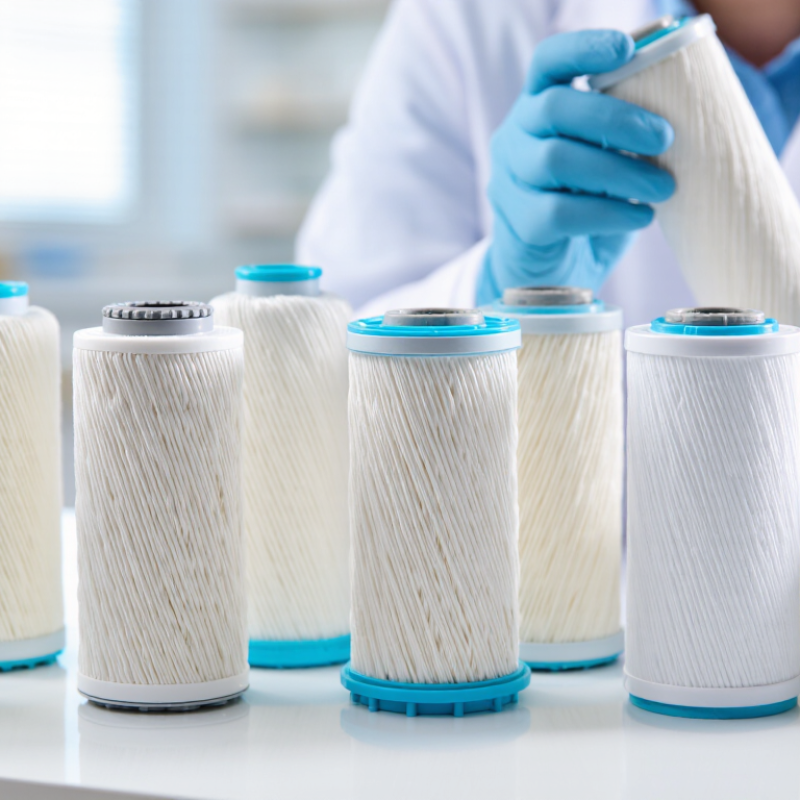
Choosing a string wound filter cartridge starts with defining the filtration requirement, not selecting a cartridge from a catalog. Identify the target particle size and decide whether it means nominal or absolute retention. A 5-micron rating may perform differently across filter constructions. Confirm the required flow rate, acceptable pressure drop, and expected dirt load. Start with the fluid.
Fluid conditions often determine cartridge life more than the micron rating. Record viscosity at operating temperature, because thick fluid can sharply reduce flow. Check temperature, pH, chemical compatibility, and whether the fluid contains oils, solvents, solids, or biological matter. The winding material and core must tolerate these conditions without swelling, shedding, or deforming. Measure it under real conditions.
A practical assessment should include the vessel size, connection type, sealing method, and available replacement space. Compare clean pressure drop with the system’s maximum allowable differential pressure. If the process experiences sudden surges, include a safety margin. Incomplete data is common. Do not hide that gap. Test a sample under representative flow and temperature, then inspect the cartridge for uneven loading or channel formation. One overlooked detail is fluid variability; a cartridge suitable for clean water may fail quickly when suspended solids increase after maintenance or seasonal changes. Keep operating records, since field evidence is often more useful than assumptions.
How to Choose String Wound Filter Cartridges?
Material selection should match the liquid, temperature, and contaminant load. Polypropylene resists many chemicals and suits general industrial water treatment. Cotton can provide effective depth filtration, but it may swell or shed fibers in unsuitable liquids. Polyester offers better strength in some demanding applications. Glass fiber supports fine filtration, although it can be less forgiving during handling. Stainless steel is useful for higher temperatures and repeated cleaning, but it usually costs more.
Construction matters as much as material. A tightly wound cartridge can capture smaller particles near its surface and may load quickly. A graded-density winding holds larger debris outside and finer particles deeper inside. Check the core strength, end-cap seal, and cartridge length before installation. DOE and SOE designs require different housings and sealing methods. In plant inspections, poor sealing often causes bypass, even when the filter rating looks correct. That detail is easy to miss.
Tips
Ask for the test method behind the micron rating. Nominal and absolute ratings are not interchangeable. Compare pressure drop at the actual flow rate, not only the catalog value. Inspect the first used cartridge: its color, sludge pattern, and collapse marks reveal operating conditions. No choice is perfect. A cartridge that lasts longer may provide less protection at the target flow. When uncertain, run a controlled trial with two construction options and record pressure, service time, and filtrate clarity.
| Material / Construction | Typical Micron Range | Typical Continuous Temperature Capability | Main Advantages | Limitations and Compatibility Considerations | Recommended Applications |
|---|---|---|---|---|---|
| Polypropylene String | Approximately 1–100 µm, depending on winding density and cartridge design | Up to approximately 80–90°C in many standard designs | Broad chemical resistance; low extractables; good resistance to acids, alkalis, and many aqueous process fluids; does not support biological growth. | Limited resistance to strong oxidizers and some aggressive solvents. Temperature and pressure limits vary by core, adapter, and end-cap materials. | Water treatment, prefiltration, plating solutions, process water, chemicals, and general-purpose industrial liquids. |
| Cotton String | Approximately 1–100 µm | Usually suitable for moderate-temperature service, often up to approximately 60–80°C | Good adsorption of some oils and organic compounds; effective for many general-purpose liquid filtration duties; economical. | Can swell or degrade in water-based or alkaline conditions; may release natural fibers or extractables; poor resistance to microbial growth and strong chemicals. | Oil filtration, fuel-related service, selected solvent applications, and processes where natural-fiber media are acceptable. |
| Polyester String | Approximately 1–100 µm | Often suitable up to approximately 120°C, subject to cartridge construction | Better thermal performance than many natural-fiber options; good mechanical strength; useful resistance to dilute acids and many organic liquids. | Chemical resistance is not universal. Strong alkalis, concentrated acids, and certain solvents may attack the fiber or reduce service life. | Industrial process liquids, oils, coatings, resins, and applications requiring higher temperature capability than cotton. |
| Fiberglass String | Approximately 1–100 µm | Often suitable for approximately 150–260°C, depending on binder, core, and end-cap materials | High temperature resistance; good dimensional stability; strong resistance to many chemicals; suitable for demanding industrial filtration. | May be brittle; loose fibers must be controlled; binder and hardware compatibility can limit maximum temperature and chemical resistance. | High-temperature oils, solvents, hydraulic fluids, chemical processing, and applications requiring low media deformation. |
| Stainless Steel Wire | Commonly approximately 5–100 µm, depending on mesh and winding pattern | Potentially above 300°C when the complete cartridge is designed for high-temperature service | Excellent mechanical strength; reusable in suitable applications; high temperature capability; resistant to media migration when properly constructed. | Higher purchase cost; not resistant to every chemical, especially certain chlorides and strong reducing or oxidizing environments; cleaning validation is required for reuse. | High-temperature liquids, lubricants, hydraulic systems, aggressive industrial service, and applications requiring cleanable metal media. |
| Surface-Wound Construction | Nominal or absolute ratings may be offered; commonly approximately 1–100 µm | Determined primarily by the string, core, and end-cap materials | Controlled pore openings at the media surface; good depth-loading capability; can provide a useful balance between dirt-holding capacity and particle retention. | Actual retention depends on winding tension, string diameter, density, and flow direction. A nominal rating should not be treated as an absolute rating. | General industrial liquid filtration, prefiltration, cooling water, and applications with variable particle sizes. |
| Dense Gradient-Wound Construction | Commonly available from approximately 1–50 µm | Determined by the media, core, end caps, and seal materials | Looser outer winding and progressively tighter inner winding can provide greater dirt-holding capacity while maintaining finer retention near the core. | Pressure drop can rise as the cartridge loads. Performance depends strongly on manufacturing consistency and the stated test method. | Pretreatment before membrane filters, high-solids process liquids, water polishing, and applications requiring extended cartridge life. |
| Coreless or Low-Hardware Design | Depends on the selected string material and winding density | Depends on the media and process conditions | Reduces internal hardware and may reduce extractables or disposal mass; useful where the process requires a predominantly fiber-based cartridge. | May have lower collapse resistance than a reinforced-core design. Differential-pressure limits must be checked carefully. | Low-to-moderate pressure liquid filtration and applications where reduced hardware contact is beneficial. |
| Reinforced-Core Design | Depends on the selected string material and winding density | Limited by the lowest-rated component in the assembly | Higher resistance to collapse, improved dimensional stability, and better suitability for higher differential pressure or viscous liquids. | Adds material cost and potential extractables. Core material must be compatible with the process fluid and operating temperature. | High-flow systems, viscous liquids, elevated differential pressure, and installations subject to hydraulic surges. |
| Standard Open-End Cartridge | Available across most common string-wound ratings | Determined by the complete cartridge assembly | Broad equipment compatibility when the housing uses a standard open-end configuration; easy replacement and wide availability. | Seal configuration and end-cap dimensions must match the housing. Bypass around the seal can occur if the cartridge is incorrectly fitted. | General-purpose cartridge housings and routine industrial liquid filtration. |
| Gasketed, Finned, or Custom-End Construction | Depends on the selected media and winding configuration | Determined by media, gasket, end cap, and housing materials | Can improve sealing, alignment, and resistance to bypass in specialized housings or demanding process installations. | Less interchangeable than standard designs. Gasket elastomer compatibility, compression, and installation orientation must be verified. | Dedicated process housings, sanitary or critical applications, and systems requiring enhanced sealing control. |
Note: Micron ratings, temperature limits, pressure-drop performance, and chemical compatibility are typical industry ranges rather than universal specifications. Final selection should be based on the fluid composition, viscosity, operating temperature, flow rate, differential-pressure limit, required retention efficiency, housing configuration, and the cartridge manufacturer's validated data.
Choosing a string wound filter cartridge starts with the contaminant, not the product label. A 5-micron cartridge may remove visible sediment, but its performance depends on whether the rating is nominal or absolute. Nominal ratings allow some particles to pass. Absolute ratings are tighter, but they can increase pressure loss. ISO 16889 uses beta ratios to evaluate particle removal under controlled conditions. Ask for the test method and operating flow.
Micron selection should match the process risk. For drinking-water pretreatment, a 10-micron cartridge can protect downstream equipment from sand and rust. A 1-micron option may better control fine particles, but it can load quickly. The World Health Organization recommends turbidity below 1 NTU for effective disinfection, with a preferred target below 0.5 NTU. That target does not automatically require a 0.5-micron cartridge. Water chemistry, flow, and disinfection design still matter.
Dimensions are equally important. Check cartridge length, outside diameter, inside diameter, end-cap style, and gasket material. A cartridge can look compatible yet bypass water through a loose seal. Measure the housing before ordering. Record inlet pressure, flow rate, and the clean-cartridge pressure drop. Replace the element when pressure loss reaches the equipment supplier’s limit, not only when the cartridge looks dirty. This is where specifications can mislead. Real water rarely behaves like a laboratory sample. A pilot test with a pressure gauge may reveal that a longer cartridge performs better than a finer one.
How to Choose String Wound Filter Cartridges?
Compatibility is the first practical check when selecting a string wound filter cartridge. Confirm that the filtration material suits the fluid, temperature, and chemical exposure. Polypropylene, cotton, and other media do not perform equally in every process. Examine the cartridge dimensions, connection style, core construction, and sealing materials. A cartridge may fit the housing but still react poorly with the process fluid. This is an easy mistake to make.
Flow capacity needs careful interpretation. A lower micron rating does not automatically mean better performance. Smaller openings can increase pressure drop, especially when the fluid is viscous or contains heavy sediment. Check the manufacturer’s flow data at your actual fluid temperature. Then compare clean-cartridge pressure loss with the available pump pressure. I have found that real systems often flow less than laboratory figures. Pilot testing is wiser than guessing.
Operating limits protect both equipment and product quality. Review maximum pressure, temperature, differential pressure, and collapse resistance. Consider whether the cartridge will face repeated pressure changes or sudden flow increases. Monitor pressure before and after the filter during operation. Replace the cartridge when pressure loss approaches the site’s approved limit, not only when flow stops. Some specifications can seem clear but still leave practical questions. Record the fluid condition, service time, and pressure trend during the first trial. That record supports a more reliable choice.
Choosing a string wound filter cartridge requires more than matching the micron rating. Service life depends on solids loading, liquid viscosity, flow rate, temperature, and pressure. In field inspections, a cartridge may look clean while its pressure drop steadily rises. A differential pressure gauge provides better evidence than appearance alone. Record inlet and outlet pressure during normal operation. Small changes matter. If pressure drop reaches the equipment manufacturer’s recommended limit, plan replacement before flow becomes unstable.
Maintenance starts with a simple log. Note the installation date, process conditions, pressure readings, cleaning events, and removal reasons. Inspect the housing seal and cartridge seating during every change. A loose seal can imitate poor filtration and create bypass risk. Confirm that cartridge materials suit the process liquid and operating temperature. Do not wash or reuse a cartridge unless approved instructions allow it. Rinsing can damage the winding structure or move trapped solids downstream. That mistake is easy to make.
Replacement intervals should reflect actual data, not a convenient calendar. Heavy sediment may shorten service life dramatically, while clean feedwater may extend it. Set an initial inspection interval, then adjust it after several operating cycles. Keep a spare cartridge available when shutdowns are costly. Still, prediction is imperfect. Unexpected changes in raw water, pump output, or seasonal temperature can alter loading overnight. Review these events before changing the specification. A lower micron rating is not automatically better; it may increase pressure drop and maintenance frequency.
Evaluate service life, maintenance, and replacement needs
Finer cartridges generally provide greater particle removal but can create a higher initial pressure drop and reach their replacement point sooner in heavily contaminated water. The values shown are representative engineering reference values for a 10-inch cartridge tested at 10 L/min; actual performance depends on cartridge length, winding density, fluid viscosity, flow rate, and contaminant concentration. Replace the cartridge when the differential pressure approaches the process limit, commonly around 0.7 bar above the clean pressure.