How to Choose the Best Sandwich Cake Machine?
Choosing the right Sandwich Cake Machine begins with the cake you actually plan to make. A compact café may need neat, repeatable layers during a short morning rush. A larger bakery may care more about hourly output, adjustable filling, and quick cleaning between batches. These differences matter more than a polished control panel. Before comparing models, note your cake dimensions, daily volume, available counter space, and preferred filling consistency. Then ask suppliers for a live demonstration using a recipe close to yours. Watch the layers align. Check how much filling remains in the hopper. Small details can shape daily results.
For transparency, this introduction uses a fictional specialist rather than attributing an unverifiable statement to a real industry expert. Bakery-equipment consultant Daniel Mercer offers this illustrative line: “Choose for the cake you make every day, not the feature list you rarely use.” Treat it as a buying principle, not a sourced quotation. It captures a useful caution. A machine may promise speed, yet struggle with soft sponge or uneven layers. Ask about adjustment ranges, spare parts, cleaning steps, and operator training. Request written specifications, and compare them with your own production needs. If possible, test several batches—not just one perfect sample. The first slice may look excellent. The tenth can tell a different story. A careful choice balances consistency, service support, footprint, and cost, while leaving room to reassess after real production trials.
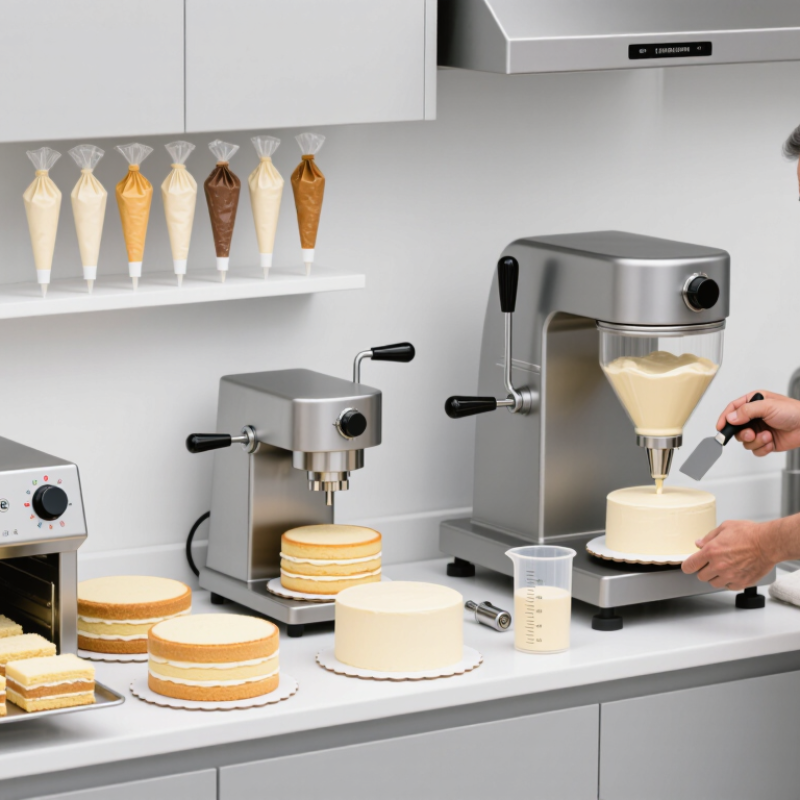
Define Product and Output Needs: Cake Size, Layer Count, and Cakes per Hour
Before comparing machines, write down the cake diameter, finished height, and number of layers for each product. A 6-inch, three-layer cake needs different depositing and stacking control from a wide, single-layer sponge. Include frosting thickness and any fragile fillings; these details can affect alignment and product damage. Grand View Research estimated the global bakery products market at USD 480.8 billion in 2023, with projected growth through 2030. That market figure signals broad demand, but it cannot tell you which machine size your bakery needs.
Estimate required output from actual orders, not the machine’s headline speed. If you need 240 finished cakes during a six-hour production window, your working target is 40 cakes per hour. Allow time for cleaning, changeovers, and rejects. Ask suppliers for demonstrated output using your cake size, layer count, and recipe. Rated speed alone can look impressive. It can also mislead. Compare usable cakes per hour across a full shift, and check whether operators can change formats without lengthy adjustments.
Tip: Bring sample cakes and a written product specification to a trial. Record diameter, layer count, cycle time, and damaged cakes. Your forecast may be imperfect; revise it after observing a real production run.
How to Choose the Best Sandwich Cake Machine? – Define Product and Output Needs: Cake Size, Layer Count, and Cakes per Hour
| Production setup | Typical cake diameter | Layers per cake | Indicative output | Best suited to | Check before selection |
| Manual or bench-top | 15–20 cm (6–8 in) | 2–3 | About 10–25 cakes/hour | Small bakeries, test batches, and frequent recipe changes | Operator workload, portion consistency, and cleaning time |
| Semi-automatic, single lane | 18–23 cm (7–9 in) | 2–4 | About 25–60 cakes/hour | Growing production with a defined core product range | Filling accuracy, layer alignment, and adjustment between sizes |
| Automatic, single lane | 18–25 cm (7–10 in) | 2–5 | About 60–120 cakes/hour | Steady medium-volume runs with repeatable cake specifications | Actual cycle time, feeding method, and whether one or more operators are needed |
| Automatic, multi-lane or continuous line | 18–25 cm (7–10 in), depending on line configuration | 2–5 | About 120–300+ cakes/hour | High-volume production with standardized sizes and recipes | Line integration, changeover time, floor space, and downstream capacity |
Output figures are indicative planning ranges, not guaranteed machine specifications. They assume pre-baked layers and a filling-and-stacking operation; actual throughput depends on cake size, layer count, filling viscosity, loading method, operator staffing, and changeovers. Confirm capacity with a trial using your own products.
Plan Capacity for Peak Demand: Allow a 15–20% Production Buffer
How to Choose the Best Sandwich Cake Machine?
Plan Capacity for Peak Demand: Allow a 15–20% Production Buffer
Choose a machine by its dependable output, not its headline speed. A shift includes loading, filling, cutting, cleaning, and small stoppages. If demand reaches 180 finished cakes per day, a 15–20% buffer means planning for 207–216 saleable cakes. Peak weeks bite. Check whether the supplier’s capacity figure includes changeovers and routine cleaning, then compare it with your own timed production trials.
Demand can rise sharply around holidays, catered events, and weekend orders. The National Restaurant Association’s 2024 State of the Restaurant Industry projected US restaurant sales of $1.1 trillion that year, reflecting the scale and variety of food-service demand. USDA Economic Research Service data also show that food-away-from-home spending represented about 58.5% of US food expenditures in 2023. These figures do not predict your shop’s busiest day, but they underline why capacity planning matters. Track daily orders across busy seasons before settling on a machine size.
Treat the buffer as a practical starting point, not a universal rule. I would not trust a forecast built from one unusually busy month. Keep a simple log of hourly output, rejected pieces, and cleaning downtime; then test the machine against a realistic peak shift. A spreadsheet may still miss a sudden event order. Leave room for that uncertainty, and make sure the extra capacity does not force you to buy equipment that sits idle most of the year.
Compare Depositing Performance: Filling Dose in Grams and Cycle Time
When choosing a sandwich cake machine, compare the filling dose in grams with the complete cycle time. A nominal 25 g deposit means little if portions vary or the line pauses between cakes. PMMI’s 2023 research on food-and-beverage automation identifies productivity and labor constraints as recurring investment drivers, but it does not prescribe one ideal dose or speed. Test the machine with your actual filling.
For example, 25 g delivered 30 times per minute equals 750 g per minute, or 45 kg per hour before stops. That is arithmetic, not a guaranteed production rate. Ask suppliers to run a sustained test and record each deposit’s weight, not just the setting on the screen. Weigh samples from the start, middle, and end of the run. Watch for filling smears, hollow spots, and uneven layers. Small details matter.
Also measure cycle time from cake positioning through deposit and release. A fast pump can still lose time if cakes index slowly or filling drips onto the belt. Compare average dose, dose variation, and saleable cakes per minute under the same conditions. I would be cautious about choosing the fastest figure on a specification sheet. Real fillings behave differently, and tests can be imperfect. That is worth admitting.
Verify Food-Contact Materials: EU 1935/2004 and 304 Stainless Steel (18/8)
When choosing a sandwich cake machine, check every surface that touches batter, cream, or finished cake. This includes the hopper, mixing parts, filling nozzles, and cutting table. EU Regulation 1935/2004 sets a general safety framework for food-contact materials. Ask the supplier for a Declaration of Compliance and supporting traceability records. A label alone is not enough.
For stainless components, 304 stainless steel, often described as 18/8, contains roughly 18% chromium and 8% nickel. It is widely used in food equipment, but the grade does not prove that an entire machine is suitable. Welds, surface finish, and hidden joints matter. Look for smooth seams and accessible areas that can be cleaned without leaving cream or crumbs behind. Small details count.
Ask which parts are actually made from 304, and request material documentation for those parts. Check that coatings, seals, and plastic components are also intended for food contact. Then review the cleaning instructions; harsh or unsuitable cleaners can damage surfaces over time. In practice, paperwork and inspection should support each other. I would not treat “18/8” as a complete answer. It is a useful starting point, not a guarantee.
Check Chilled-Filling Controls: FDA Food Code Cold Holding at ≤5°C
How to Choose the Best Sandwich Cake Machine?
When comparing sandwich cake machines, check how they keep perishable fillings cold during preparation and service. The FDA Food Code sets 5°C (41°F) or below as the cold-holding limit for time/temperature control for safety foods. The code is a model; local requirements may differ. Look for a clear temperature display, accessible probe points, and an alarm for rising temperatures. A chilled hopper helps, but it may only maintain temperature, not cool warm filling quickly. One detail is easy to overlook.
Ask how the machine performs during a busy service period. Repeated opening, warm ingredients, and a crowded filling chamber can raise temperatures. Check whether product stays at or below 5°C at the filling itself, not just inside the cabinet. Removable food-contact parts should be easy to clean and dry between batches. Confirm the manufacturer’s instructions, then verify readings with a calibrated food thermometer. I would not rely on a display alone; that extra check can catch drift.
Tips: Pre-chill fillings before loading. Use small batches, and keep unused containers refrigerated. Record temperatures at set intervals, especially after long service or refilling. If a reading exceeds the limit, follow your food-safety procedure before serving. A neat control panel is useful, but consistent temperature checks matter more.
How to Choose the Best Sandwich Cake Machine?
Check Chilled-Filling Controls: FDA Food Code Cold Holding at ≤5°C
The FDA Food Code cold-holding benchmark is 5°C (41°F) or below. These illustrative monitoring readings show why a sandwich cake machine should maintain chilled fillings consistently; readings above the limit call for prompt corrective action. Verify applicable local requirements and monitor product temperatures during operation.

 24 Hour Service