
24 Hour ServiceHigh Mast Lighting supports large outdoor spaces where even coverage, dependable operation, and safe maintenance matter. Airports, ports, logistics yards, stadiums, and industrial sites all have different lighting needs. A tall pole beside a container terminal, for example, must illuminate wide working areas without creating distracting glare for drivers or operators. One specification will not suit every project.
For global buyers, comparing China’s High Mast Lighting Manufacturers means looking beyond price and catalog photos. Review photometric files, pole and bracket designs, driver details, corrosion protection, and wind-load calculations for the project location. Ask how the supplier checks production quality and whether sample components or factory inspection can be arranged. Verify test reports and product certifications against the requirements of the destination market; a document’s presence alone does not confirm suitability. Small details count. Packaging, spare parts, warranty terms, and realistic lead times can affect installation long after an order is placed.
A capable manufacturer should answer technical questions clearly and provide records that buyers can review. Still, no shortlist is perfect. A responsive sales team does not automatically prove consistent production, and a low quotation may leave important items unclear. Compare like with like, request written specifications, and confirm responsibilities before production begins. This guide introduces factors to consider when assessing Chinese suppliers, while recognizing that the best choice depends on the site, budget, and service expectations. Even careful checks cannot remove every risk. They can make the decision more informed.
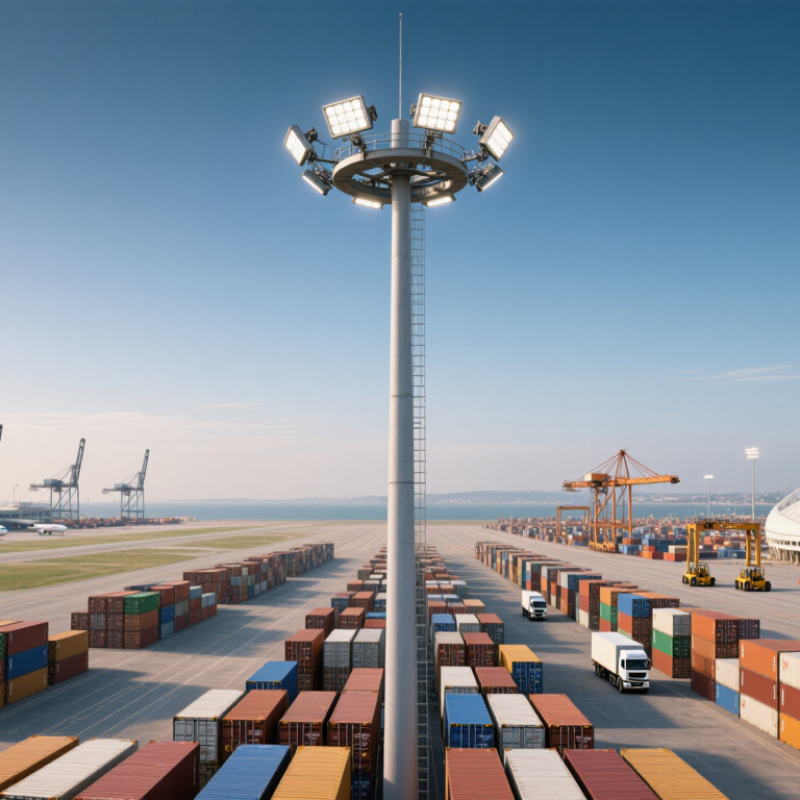
High mast lighting uses tall poles, often 20 to 50 metres high, to illuminate broad outdoor areas with fewer mounting points. Typical sites include ports, airports, freight yards, sports grounds, and major road junctions. At a port, evenly spaced poles can light container lanes and crane routes. Good design limits dark patches and glare for drivers and ground crews.
Energy performance matters across large sites. The U.S. Department of Energy’s Energy Saver guidance reports that LED lighting uses at least 75% less energy than incandescent lighting. That comparison is not a direct promise for every high-mast retrofit: existing fixtures, optics, operating hours, and control settings change results. A pole that looks powerful on paper may still create uneven ground illumination. Photometric layouts and on-site checks are essential.
Tips: Ask for a maintained-illuminance plan, glare review, wind-load data, and a safe lowering or access method. Check how fixtures perform in rain, dust, and vibration. Do not judge a system by lumen output alone. Real sites are messier than drawings.
| Application | Typical High Mast Height* | Common Lighting Objective | Key Design Considerations |
|---|---|---|---|
| Ports and container terminals | Approximately 25–50 m | Illuminate large cargo-handling and storage areas for night operations. | Consider crane activity, equipment movement, corrosion exposure, wind loading, glare control, and maintenance access. |
| Airports and aircraft aprons | Approximately 20–45 m | Provide broad, even illumination for apron areas, service roads, and aircraft parking zones. | Limit glare toward pilots and control towers; coordinate pole locations with aircraft clearances and airport requirements. |
| Highway interchanges and toll plazas | Approximately 20–40 m | Cover wide junctions, ramps, and other road areas where conventional roadside poles may leave gaps. | Assess driver visual comfort, uniformity, spill light, pole clearances, and applicable roadway lighting standards. |
| Sports fields and stadium surroundings | Approximately 20–50 m | Light playing areas, spectator approaches, parking, or other expansive outdoor zones. | Match aiming and light levels to the sport and event requirements; manage glare, spill light, and any broadcast needs. |
| Industrial yards and logistics parks | Approximately 20–40 m | Support nighttime loading, vehicle circulation, material handling, and perimeter visibility. | Account for work tasks, traffic routes, nearby buildings, environmental conditions, and safe servicing arrangements. |
*Height ranges are indicative examples, not universal specifications. Final mast height, luminaire quantity, aiming, and light levels should be determined through a site-specific photometric design and checked against applicable local standards and safety requirements.
A high mast lighting system combines a steel pole, luminaires, brackets, electrical equipment, and a foundation designed for site conditions. Pole height and wall thickness should reflect wind exposure, soil data, and the weight of the installed equipment. A structural review matters. A strong pole can still fail if its foundation or anchor bolts are poorly matched to the ground.
The lighting package should specify output, beam distribution, colour temperature, ingress protection, and surge protection. Photometric calculations help confirm that light reaches the target area without leaving dark patches or creating excessive glare.
Check the maintenance method, too: lowering systems can simplify servicing, but their winch, cable, and locking parts need inspection. Small details matter. Electrical drawings should show circuit protection, cable sizes, grounding, and control options such as timers or photocells. Ask for test reports and component datasheets, then compare them with the project requirements rather than relying on headline wattage. Exact specifications vary by location, and early estimates are sometimes optimistic. Recheck assumptions against measured site data before procurement.
China’s high mast lighting manufacturing landscape combines steel-pole fabrication, luminaire assembly, and project-specific engineering. Some suppliers manage several stages in-house; others work with specialist subcontractors. That distinction matters. Buyers should review engineering drawings, material specifications, and inspection records, not just catalog images. A typical system may include a tapered steel shaft, base plate, access provisions, and either a lowering system or fixed maintenance access. Optics and light sources are selected around pole height, road or site layout, and glare requirements. Details vary by project.
Manufacturing capabilities differ widely. Ask how welds are inspected, how hot-dip galvanizing is measured, and whether wind-load calculations match the proposed site conditions. Request photometric files and clear electrical and ingress-protection specifications. Check that the pole’s sections, anchor bolts, and lifting arrangements suit local installation equipment. Paperwork matters. It should identify materials and test methods, rather than offer vague assurances. Factory visits or third-party inspections can help verify production controls, though they cannot replace a careful review of project drawings. Documentation quality can vary; buyers should question gaps before approving production.
Global buyers evaluating Chinese high mast lighting manufacturers should look beyond catalog photos and quoted prices. Ask for project references with comparable pole heights, wind conditions, and operating hours. A supplier’s experience with stadiums may not translate directly to ports or industrial yards. Details matter.
Review engineering documents before discussing large orders. Request wind-load calculations, foundation recommendations, lighting simulations, and drawings showing pole sections and access systems. Check whether the proposed illumination levels match your site layout, not just a generic sample image. Ask how the manufacturer controls steel thickness, galvanizing quality, weld inspection, and coating consistency. A small variation can become visible across a row of tall poles. It happens.
Product testing deserves the same attention. Examine reports for ingress protection, electrical safety, thermal performance, and surge protection, then confirm that the tested configuration matches the quoted product. Ask to see sample inspection records and component traceability. Verify certificates and documentation against the requirements of your destination market; paperwork alone does not prove production quality. If practical, arrange an independent factory inspection or witness a sample test. Discuss spare parts, replacement lead times, warranty exclusions, and the process for handling defects. One uncomfortable question is useful: what happens when a driver fails after several years? A clear, specific answer is more valuable than a polished promise.
How Global Buyers Can Evaluate Chinese Manufacturers
Suggested buyer evaluation weights, totaling 100 points. Assess each supplier against documented product testing, relevant certifications, engineering capability, warranty terms, and export references. Adjust the weights to match project requirements; these are a sourcing framework, not market statistics or ratings of specific manufacturers.
For global buyers, export readiness means more than a shipping certificate. Check that luminaires are tested against applicable requirements, including IEC 60598-1 and IEC 60598-2-5 for floodlights. Request complete test reports, photometric files, wiring diagrams, and destination-specific conformity documents. Requirements differ by market, so confirm acceptance with the local project engineer before ordering. One common blind spot: a certificate alone does not prove that the supplied configuration matches the tested product.
Installation support should cover wind-load calculations, foundation and anchor-bolt drawings, cable schedules, and safe winch operation. The IEA’s Lighting analysis reports that lighting uses about 15% of global electricity, making optical performance and commissioning checks important. After-sales terms should state warranty coverage, spare-parts availability, response times, and access to replacement drivers. A clear handover pack helps, though paperwork cannot replace a technician who understands the site.
Tips: Before shipment, match pole height, luminaire aiming, and control settings against approved drawings. Keep a few critical spare parts on site; downtime at a busy junction is costly. One detail buyers may overlook: translated manuals need to be usable, not merely translated.