
24 Hour ServiceChoosing among China’s Sip Video Door Phone suppliers takes more than comparing catalog prices. Buyers need to assess SIP interoperability, audio clarity, camera performance, firmware support, and production consistency. A door phone may look impressive in a product photo, yet fail during a simple test: a call drops when the indoor monitor answers. Small details matter.
Industry data offers useful context, but it should not be overstated. MarketsandMarkets estimated the global video surveillance market at USD 53.7 billion in 2023 and projected USD 83.3 billion by 2028. That report covers a broader category, not SIP video door phones alone. Still, it reflects sustained investment in connected security systems and helps explain why buyers expect reliable video, network integration, and long-term support. SIP itself is standardized in IETF RFC 3261, making protocol compatibility a practical supplier question—not just a feature-list claim.
This guide examines suppliers through evidence buyers can verify: documented SIP compatibility, sample testing, manufacturing capabilities, customization terms, warranty coverage, and responsiveness after delivery. Ask for a working sample. Test it on your intended network, check call quality through a closed door, and confirm how firmware updates are handled. Trade-show claims can sound polished. Real performance is less tidy. No supplier is best for every project, and public rankings rarely reveal enough to prove otherwise. The comparisons ahead focus on fit, verifiable capabilities, and the questions worth asking before placing an order.
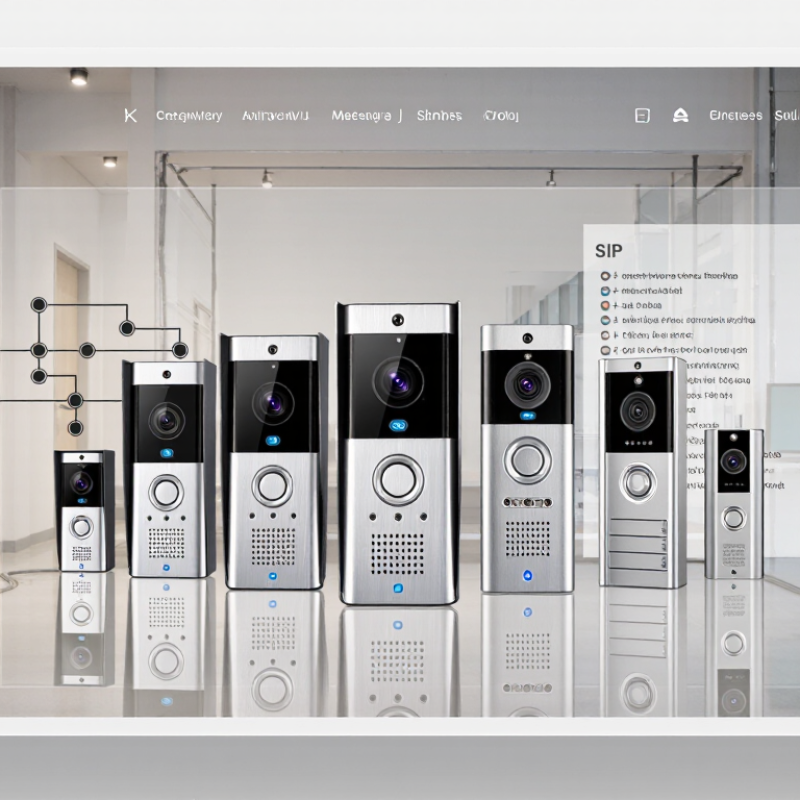
A SIP video door phone is an entry device that uses an IP network and Session Initiation Protocol (SIP) to connect a visitor’s call with an indoor monitor, desk phone, or authorized mobile endpoint. At the entrance, a visitor presses a button, and the system can send live video and two-way audio to the chosen device. The resident can see the caller, speak through the microphone, and, if the system is configured for it, release an electric door lock.
The parts are practical and visible: a camera above the call button, a speaker grille, a network cable, and a screen showing the entrance in real time. Many units use Power over Ethernet, which can carry power and data through one cable. SIP can also help devices communicate with compatible phone systems, but compatibility depends on settings such as network details, codecs, and call routing. It is not always plug-and-play.
A clear picture does not guarantee clear speech; poor microphone placement or network congestion can still affect a call. That detail is easy to overlook. When comparing suppliers, ask for installation guidance, compatibility information, and evidence of testing under realistic network conditions.
A SIP video door phone supplier should be evaluated on interoperability, image quality, security, and long-term support—not a polished demonstration alone. MarketsandMarkets estimated the global video-surveillance market at US$53.7 billion in 2023 and projected US$83.3 billion by 2028. This signals growing demand, but it does not prove that any supplier’s door phone performs well. Treat market figures as context, not a quality score.
Check whether the device works with your SIP server, indoor stations, and network settings. The IETF’s SIP specification, RFC 3261, provides a baseline for assessing protocol compatibility. Ask suppliers for test records covering call setup, two-way audio, video delay, and recovery after a network interruption. Test the edge cases. For example, place a call in a noisy lobby, then open the door remotely while the video is streaming. Confirm that access logs and user permissions behave as expected.
Review security-update policies, warranty terms, spare-part availability, and technical response times in writing. Ask for environmental test conditions, such as operation in heat, rain, or dust, rather than relying on a general “outdoor-rated” claim. A neat lab demo can still miss problems in a real building. Supplier comparisons are imperfect, too: test results may use different networks and methods, so request comparable evidence before deciding.
China’s SIP video door phone supplier landscape includes manufacturers focused on indoor monitors, outdoor calling panels, and complete systems built around SIP communication. Some suppliers specialize in customized hardware, while others offer configurable platforms for property developers and system integrators. Product sheets may look similar, but practical differences show up in details: camera performance in dim corridors, microphone clarity near busy streets, and screen response after repeated daily use.
A reliable evaluation starts with the intended installation. Check SIP compatibility, network requirements, power options, and integration with existing access-control equipment. Ask for current test samples and documentation, then verify how firmware updates and technical support are handled. Details matter. A polished demonstration does not always reflect performance across a large building or mixed network. Supplier capabilities can also vary by project; production capacity alone says little about long-term service. The landscape is broad, and not every supplier is equally transparent. That can be inconvenient. Buyers should compare response times, sample consistency, and customization limits before committing, while leaving room for a modest lesson: specifications rarely answer every installation question.
| Supplier type | Typical product scope | SIP and interoperability | Customization and integration | Best suited for | What to verify before ordering |
|---|---|---|---|---|---|
| Intercom-focused manufacturer | Door stations, indoor monitors, concierge stations, and related intercom accessories. | May offer SIP-based calling; supported SIP versions, codecs, and third-party compatibility differ by model. | Often focused on intercom functions such as calling, directory lookup, and door release. Confirm API or integration support separately. | Projects where intercom functions and coordinated door-station and monitor options are priorities. | Request a model-specific datasheet, SIP configuration guide, and a live test with your PBX or SIP server. |
| Access-control-focused manufacturer | Video door stations combined with access functions such as credential readers, relays, or door controllers. | SIP calling may be available alongside access-control features; verify whether the two functions work together in the intended setup. | May support card, PIN, or other credential options depending on the product. Reader formats and controller interfaces are model-specific. | Installations that need visitor communication and controlled door entry in one deployment. | Check credential compatibility, relay ratings, wiring diagrams, and how access events are managed or logged. |
| OEM/ODM electronics manufacturer | Configured or customized hardware and software based on a buyer’s product requirements. | SIP support depends on the selected platform and specification; compatibility should be demonstrated on production-intent hardware. | Potential options include enclosure, interface, firmware, language, or packaging changes, subject to engineering scope and order terms. | Buyers developing a private-label product or requiring a defined hardware configuration. | Confirm ownership of firmware and tooling, minimum order quantities, change-control procedures, and ongoing software support. |
| Security-system integrator or exporter | Sourced video door phones bundled with related security products, project coordination, or export services. | Capabilities depend on the selected product and upstream manufacturer; the seller may not control device firmware. | May assist with product selection and system-level coordination. Responsibility for integration and after-sales support should be defined in writing. | Buyers seeking a coordinated package or help consolidating products for a project. | Identify the actual manufacturer, warranty provider, technical-support contact, and party responsible for resolving compatibility issues. |
| Network-video-oriented supplier | IP video door stations designed to work within network-video or video-surveillance environments. | SIP and video-stream interoperability are separate checks. ONVIF support, where offered, is product- and profile-specific. | May offer network video functions alongside calling and access features; integration with a third-party VMS must be tested. | Projects that need door-station video to fit into an existing IP video environment. | Ask for the exact ONVIF profile or other supported interface, stream settings, and a compatibility test with the target VMS. |
China’s SIP video door-phone suppliers tend to specialize in three areas: apartment systems, customizable OEM hardware, and integrated access control. Apartment-focused manufacturers often offer indoor monitors, outdoor stations, and management software designed to work together. OEM-oriented suppliers may provide more flexibility in screen size, housing, and interface design. Integration specialists typically focus on SIP compatibility, relay outputs, and connections to existing access-control platforms. Details vary by factory.
Market context matters, but broad figures are not product rankings. MarketsandMarkets estimated the global access-control market at USD 10.4 billion in 2023 and projected USD 15.2 billion by 2028. That category is wider than video door phones, so it signals investment in access systems—not demand for any specific supplier. For procurement, request documented SIP support, codec lists, wiring diagrams, and test results. Ask for a live demonstration with the intended PBX; “SIP compatible” can mean different things.
Look closely at the outdoor station. Check its camera angle, night image, call-button feel, and audio clarity in a noisy corridor. Ask how firmware updates and spare parts are handled after delivery. A polished sample is useful, but it is not proof of consistent production. That part is easy to overlook.
Choosing a SIP video door phone supplier starts with interoperability, not a glossy product photo. The IETF’s SIP specification, RFC 3261, defines the signaling protocol, but a standards claim alone does not prove reliable integration. Ask for a live test with your intended PBX, indoor monitor, and network switch. Check two-way audio, video delay, door-release response, and recovery after a power interruption. Small details matter.
Review the supplier’s production controls and support process. Request recent test records, firmware update procedures, spare-parts availability, and a clear warranty scope. MarketsandMarkets estimated the global video intercom devices market at USD 2.3 billion in 2023 and projected USD 3.5 billion by 2028, reflecting wider adoption and more supplier choices. Treat forecasts as market context, not proof of product quality. Ask for references from projects with similar building size and wiring conditions, then verify them directly. A sample can perform well on a quiet bench and still struggle in a busy lobby. I would not skip the site test. Suppliers may also overlook an awkward requirement, so document exceptions and response times before placing an order.
How to Choose a Supplier for Your Project
These illustrative project weights cover practical evaluation criteria, not rankings of suppliers. Prioritize SIP interoperability, video performance, and integration according to your project requirements, then verify claims through documentation and testing.