
24 Hour ServiceA Goods Lift can look like a simple box moving between floors. In a busy warehouse, though, its speed, rated load, landing access, and duty cycle affect daily throughput. A pallet that arrives late can hold up packing. A lift sized only for today’s workload may also become a bottleneck as operations grow.
The World Bank’s Logistics Performance Index 2023 assessed logistics across 139 economies, highlighting the importance of reliable, connected supply chains. MHI’s 2024 Annual Industry Report found that 55% of surveyed organizations were increasing investment in supply-chain technology and innovation. These reports do not rank lift designs. They do show why buyers should assess equipment as part of a wider material-handling system, rather than compare purchase prices alone.
The best choice depends on the building and the load. A compact hydraulic lift may suit a low-rise shop; a high-throughput warehouse may need a traction system or a purpose-built freight elevator. Buyers should check clear shaft dimensions, pallet sizes, loading methods, travel height, and expected cycles per hour. Safety features, service access, local support, and energy use deserve equal attention. Small details matter.
This guide compares common goods-lift types for global buyers in 2026, with practical strengths, trade-offs, and selection points. No single type fits every site. And specifications on paper can miss real operating conditions. A careful site assessment remains essential.
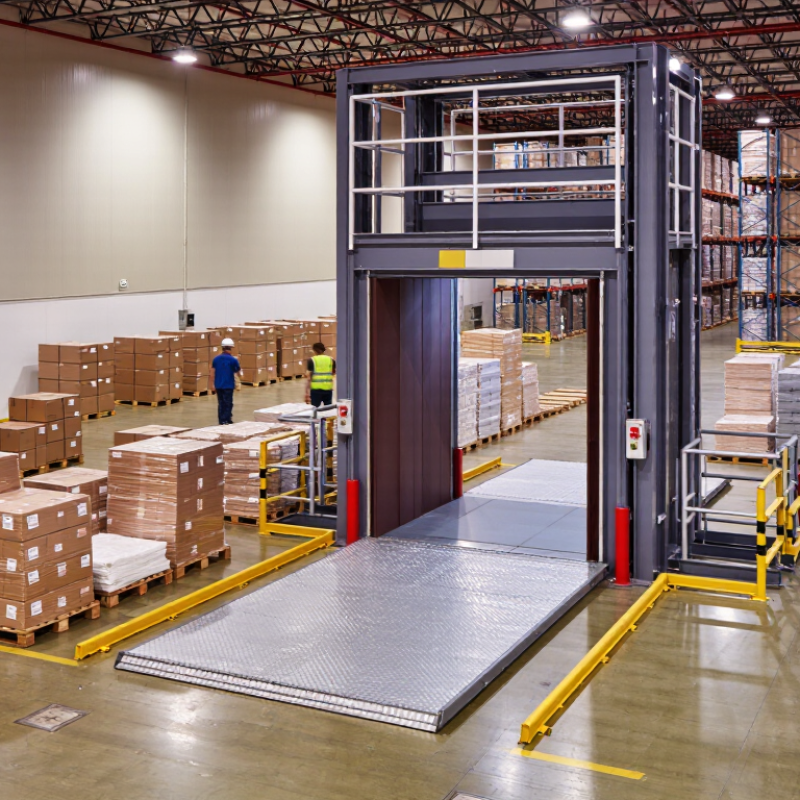
A goods lift is a powered platform or enclosed car that moves materials between building levels. It helps transfer cartons, pallets, tools, or equipment without carrying them on stairs. Some models are designed for goods only; others allow an operator to travel with the load. The permitted use depends on the lift’s design.
The load enters through a landing door and rests on the platform or inside the car. A hydraulic system may raise it using a cylinder, while a traction system uses a motor, ropes, and often a counterweight. Controls call the lift to a floor, and interlocked doors help prevent movement while access points are open. The details vary.
It sounds straightforward. In a working warehouse, it is less so. Loads need to sit within the rated capacity and be distributed sensibly; an off-center pallet can create problems. The lift also needs suitable floor space, power, and regular inspection by qualified personnel. A practical site check matters more than a specification sheet alone. I have seen small layout details overlooked, such as a doorway that leaves too little room to turn a trolley. That is easy to miss.
Goods lifts serve different jobs, even when their rated capacities look similar. Hydraulic goods lifts suit many low-rise sites, such as workshops moving pallets between a ground floor and mezzanine. Their platform travels smoothly, but the equipment needs space for its power unit and planned maintenance.
Electric traction lifts can serve taller buildings and frequent trips, though shaft layout and installation requirements may be more demanding. Space is tight. A vertical reciprocating conveyor moves goods between fixed levels, often in warehouses. It is not designed to carry passengers.
Scissor lift tables work well for short vertical transfers near loading bays or production lines. They can raise a pallet to vehicle-bed height, but they usually do not replace a fully enclosed, multi-floor goods lift.
Not always. Buyers should compare load dimensions, travel height, cycles per hour, available floor space, and access for servicing. A 1,000-kilogram rating alone tells little if the pallet cannot fit through the gate.
Specify landing gates, interlocks, overload protection, and emergency controls, then confirm applicable local standards with a qualified lift professional. Requirements vary by location. In practice, the cheapest layout can create awkward loading angles or costly building changes; site measurements deserve a second look.
Goods lifts differ less by appearance than by the loads, travel distance, and building conditions they must handle. A small hydraulic lift can suit a workshop moving parts between two floors. It often travels at a modest speed, but that may be enough when loads are heavy and trips are occasional. Check the rated capacity against the heaviest pallet, not the average one. Add room for the pallet jack, too.
For frequent movement across several levels, a traction goods lift may offer faster travel and smoother operation. That can reduce waiting near a busy loading bay. But speed alone is not a useful target. Door cycles, loading time, and peak-hour queues affect throughput just as much. A lift rated for 1,000 kilograms may still be a poor fit if bulky crates cannot pass through its doorway.
Setting changes the choice. Warehouses may need large cabins and durable doors; compact factories may have limited shaft space. Outdoor installations face weather, temperature shifts, and more demanding protection needs. Measure the route carefully. Then compare capacity, rated speed, cabin size, and expected trips per hour with a qualified lift professional. Real sites are messy, and early estimates can be wrong. That is worth checking before ordering.
Compare indicative capacity and rated speed across common goods-lift types and settings.
Traction freight lifts are often selected for taller buildings and higher capacities, while hydraulic lifts and VRCs commonly serve low-rise, fixed routes. Construction hoists are typically temporary, site-based systems. Values are illustrative midpoints of broad, commonly specified ranges—not universal limits; actual capacity and speed depend on the design, travel height, local codes, and site conditions.
Choosing a goods lift starts with the real work pattern, not the catalogue capacity. Record the heaviest routine load, daily trips, travel height, and largest pallet or trolley. A lift carrying 1,000 kilograms twice an hour faces a different duty cycle from one making constant warehouse runs. Measure door openings and turning space, too. Small details matter.
Hydraulic systems can suit lower-rise buildings and heavy loads; traction systems may be worth assessing for frequent trips or greater travel. Match the type to site conditions, available power, loading method, and maintenance access. The U.S. Department of Energy’s 2014 industrial motor systems sourcebook reports that motor-driven systems use about 54% of U.S. manufacturing electricity. This is a broad benchmark, not a lift-specific estimate, but it shows why drive efficiency and standby use deserve attention. Ask suppliers for energy figures under your expected duty cycle, not just peak ratings. Test the route. A tidy spreadsheet can still miss awkward pallet handling or delays at busy floors, so verify the layout with operators before choosing.
| Lift Type | How It Moves Goods | Common Applications | Potential Advantages | Key Limitations and Checks | Best Suited To |
|---|---|---|---|---|---|
| Freight elevator | A powered lift serving multiple floors, with a car designed for freight handling. | Warehouses, factories, distribution centres, and multi-storey commercial or industrial buildings. | Can serve several landings and accommodate pallets, trolleys, or other unit loads when the car and doors are sized accordingly. | Requires suitable shaft space, structural planning, landing access, and installation coordination. Confirm rated load, car and doorway dimensions, loading method, traffic demand, and applicable local requirements. | Operations moving substantial or frequent loads between multiple fixed levels. |
| Goods-only lift | A lift intended to carry goods, generally with loading and unloading managed by trained personnel in accordance with the design and local rules. | Industrial buildings and back-of-house areas where freight movement is separate from passenger transport. | Separates goods flow from passenger lift traffic and can be configured around the operation’s load and handling equipment. | Check whether people may ride in the lift under the relevant local code and equipment classification. Verify access controls, loading procedures, guarding, and permitted use. | Sites that need dedicated freight movement and can manage goods loading under controlled procedures. |
| Hydraulic goods lift | A hydraulic system raises and lowers the lift platform or car; the exact arrangement depends on the design. | Low- to mid-rise industrial or commercial applications, including buildings with moderate travel requirements. | May suit installations where a hydraulic configuration fits the site and required travel; equipment can be designed for specific load and platform needs. | Assess travel height, operating frequency, machine-room or equipment-space needs, temperature conditions, maintenance access, and local energy and safety requirements. Performance varies by system design. | Projects where the building layout and duty cycle are compatible with a hydraulic system. |
| Traction goods elevator | Uses a motor-driven traction system to move a lift car, typically with counterbalancing components. | Multi-storey buildings with regular freight movement and greater travel requirements. | Can be appropriate for longer travel and sustained service, depending on the selected equipment and operating profile. | Compare rated load, travel, speed, expected starts per hour, energy use, equipment-room arrangement, and maintenance capability. Actual suitability depends on the specific design. | Buildings where travel height, traffic, and duty requirements favour a traction system. |
| Vertical reciprocating conveyor (VRC) | Moves materials vertically on a platform or carrier between designated levels; it is generally material-handling equipment rather than a passenger lift. | Factories, warehouses, mezzanines, and production lines transferring palletised or unitised goods. | Can provide a direct vertical transfer point and may fit material-flow layouts where goods are loaded and unloaded at fixed levels. | Do not assume it can carry people. Confirm guarding, access gates, loading arrangement, load stability, travel, and the applicable machinery or building regulations. | Controlled goods transfer between fixed levels where passenger access is not required. |
| Goods platform lift | Raises a platform carrying goods, often over a relatively short vertical distance. | Retail stockrooms, workshops, service areas, and small level changes between floors or platforms. | May be suitable where a full passenger-style lift installation is unnecessary and the goods transfer route is straightforward. | Check platform size, edge protection, access gates, loading position, travel, and whether the intended use is permitted by local regulations. A platform lift is not automatically suitable for transporting people. | Short, defined goods transfers with simple loading and unloading requirements. |
| Service lift / dumbwaiter | A compact lift transfers small items between floors through a small car or compartment. | Restaurants, hotels, clinics, libraries, and other buildings moving meals, documents, or supplies. | Provides a dedicated route for small goods and can reduce staff carrying items on stairs. | Car opening and internal dimensions limit the size of items. Confirm the rated load, door arrangement, cleaning needs, and that the intended goods fit safely. | Small, frequent item transfers rather than pallet or bulky-load handling. |
| Scissor lift table | A powered scissor mechanism raises or lowers a work platform, usually over a limited vertical range. | Loading bays, assembly areas, ergonomic workstations, and vehicle or conveyor interfaces. | Can bring loads to a more useful working or transfer height and integrate with a defined work process. | Usually serves a local height-adjustment task, not multi-floor transport. Check platform dimensions, rated load, guarding, pinch-point protection, and floor conditions. | Single-area lifting, loading, and height adjustment rather than vertical transport between storeys. |
For global buyers, lift safety starts with classification, not catalogue claims. Confirm whether the equipment is a goods-only lift or a goods-passenger lift; different rules may apply. Check the destination market’s code, rated load, landing-door protection, emergency lowering, and inspection requirements before ordering. Standards such as EN 81-20/50 and ASME A17.1/CSA B44 may be relevant, depending on lift type and jurisdiction. Local approval matters. The U.S. Bureau of Labor Statistics recorded 1,523 fatal work injuries in transportation and warehousing in 2023, a broad sector figure, not a lift-specific risk rate. It still reinforces why loading zones, operator training, and clear procedures deserve attention.
Installation conditions can change the right choice. Measure the floor opening, headroom, pit depth, travel height, and available power on site; drawings alone can miss a beam or drainage line. A weak handover is easy to overlook. Require load testing, safety-device checks, maintenance access, and translated operating instructions before routine use. Ask who inspects the lift, how often, and which spare parts are locally available. Keep a service log with dates, faults, repairs, and test results. A checklist helps, but it cannot replace competent inspection. One detail buyers sometimes miss: maintenance schedules should reflect usage, dust, humidity, and local service capacity—not just the supplier’s standard interval.