24 Hour ServiceChoosing the right Truck Crane Cylinder in 2026 requires more than comparing bore diameter and price. Mobile crane market reports from Grand View Research and The Business Research Company indicate continued demand for lifting equipment, driven by construction, infrastructure renewal, and equipment replacement. However, these reports usually group hydraulic cylinders within broader crane or component markets. Exact cylinder data remains limited. That matters.
A reliable selection begins with the working details. Record rated load, stroke length, mounting space, operating pressure, cycle frequency, and expected temperature range. A cylinder lifting a steel beam on a dusty roadside faces different risks than one working inside a controlled warehouse. Seal material, rod coating, bearing design, and hydraulic cleanliness can decide service life. ISO 4413 also emphasizes safe hydraulic-system design, risk reduction, and controlled energy release.
Hydraulic systems expert Brendan Casey has repeatedly emphasized, “Contamination is the single biggest cause of hydraulic system failure.” That warning deserves attention. One small metal particle can score a polished rod. A damaged seal can turn clean oil into a leaking mess. Cost is not the whole answer.
This guide compares Truck Crane Cylinder options through load capacity, durability, maintenance access, corrosion resistance, and supplier support. It also considers field experience, not only catalog figures. A perfect choice does not exist. Some recommendations may change after real operating data appears. Readers should verify every specification against the crane manufacturer’s manual, certified load chart, and qualified hydraulic engineer’s assessment.
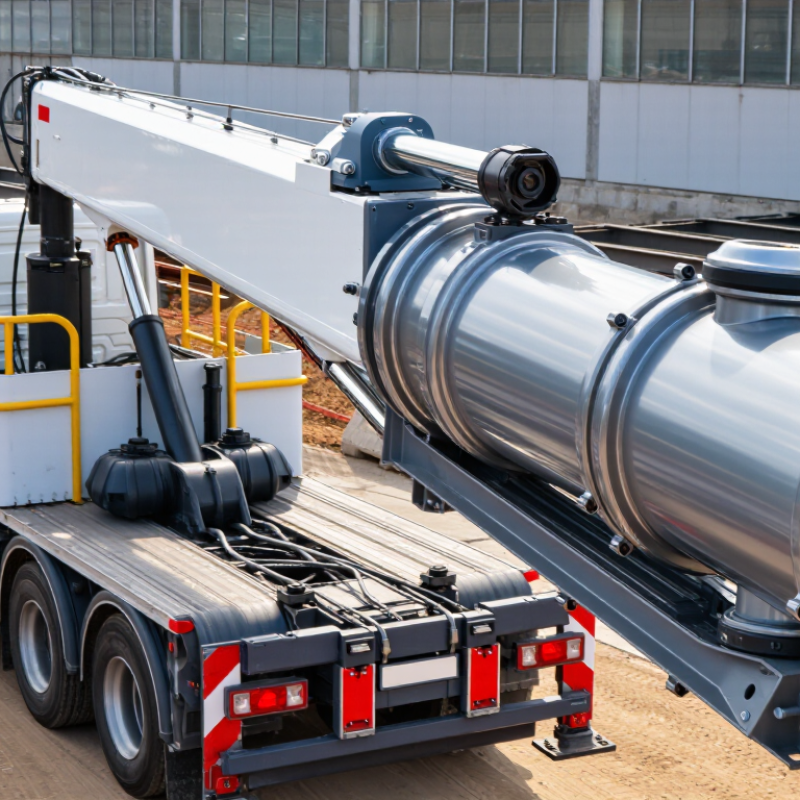
A truck crane cylinder converts hydraulic pressure into controlled lifting, folding, or extension. Its barrel contains pressurized fluid, while the piston rod transfers force to the boom or stabilizer. Common types include boom lift cylinders, telescopic cylinders, and outrigger cylinders. Each type faces different loads, strokes, and mounting angles. A telescopic cylinder reaches long distances in limited space. An outrigger cylinder needs stable extension and reliable load holding. That difference matters.
Key components include the barrel, piston, rod, seals, wiper, gland, ports, and mounting pins. The piston seal limits internal bypass. The rod seal keeps oil inside, while the wiper blocks dust and grit. During inspection, look for scoring, rust, wet gland areas, and uneven pin wear. A thin oil film may be normal. Drips are not. Measure the required stroke, retracted length, bore, rod diameter, working pressure, and connection type before selecting a replacement. Allow room for side loads. Cylinders should not act as alignment tools.
For 2026 equipment selection, match the cylinder to the rated load, hydraulic circuit, and safety controls. Choose corrosion-resistant rod finishes for outdoor work. Specify seals suited to temperature and fluid compatibility. Load-holding valves can reduce unwanted movement, but they cannot repair damaged hoses or poor maintenance. I once underestimated contamination during a routine assessment. Clean oil did not prevent seal wear because the reservoir was neglected. That mistake still shapes my checks. Service records, pressure tests, and pin alignment often reveal more than appearance. Replace questionable hardware, not only the leaking seal.
Matching a hydraulic cylinder to a truck crane starts with real load data, not catalogue dimensions. Measure the maximum lifted load, working radius, boom angle, stroke, mounting distance, and available hydraulic pressure. Cylinder force equals pressure multiplied by piston area. For example, at 250 bar, a 100 mm bore produces about 196 kN theoretically. Actual force is lower after seal friction, pressure losses, and temperature effects.
The cylinder must also fit the crane’s duty cycle. A short-stroke cylinder may suit a compact boom, while a long-stroke unit can improve reach but increase bending risk. Check the rod diameter against buckling calculations, especially when the cylinder pushes near full extension. EN 13000 addresses mobile-crane safety, while ISO 4413 covers hydraulic-system principles and risk controls. These references support specification checks, but they do not replace a site load chart.
Market data still provides useful context. Grand View Research reported continued growth in the global mobile-crane market through 2030, driven partly by infrastructure investment. More cranes mean more replacement cylinders and more pressure on maintenance teams. That trend can encourage rushed substitutions. It is a mistake.
Leave clearance around pins, hoses, and grease points. Confirm retracted length before ordering. Record oil cleanliness, operating temperature, and cycle frequency. A cylinder rated for pressure may still fail early under poor alignment. I would also recheck the calculation after field testing, because drawings rarely show every side load.
2026 Best Truck Crane Cylinder How to Choose?
Material selection determines more than lifting strength. A honed steel barrel supports smooth piston movement and reduces internal leakage. The piston rod needs hardened chrome plating and corrosion resistance, especially on trucks exposed to rain, road salt, and dust. Check yield strength, wall thickness, and fatigue calculations against the crane’s rated load. ISO 6020/2 offers useful dimensional guidance, but it does not replace application testing.
Seals deserve equal attention. Nitrile seals suit many mineral oils and moderate temperatures. Polyurethane handles abrasion well, while fluorocarbon compounds tolerate higher heat and aggressive fluids. Always compare the seal’s temperature range with real oil temperatures, not brochure estimates. The ISO 4413 hydraulic standard stresses fluid cleanliness, pressure control, and safe system design. A clean filter matters. Tiny particles can score the rod and destroy a new seal.
Market research from MarketsandMarkets estimates the hydraulic cylinder market could grow from about 14.7 billion dollars in 2023 to 20.4 billion dollars by 2028. This growth reflects demand for more efficient mobile equipment, but bigger capacity is not automatically better. Check rated pressure, stroke length, mounting geometry, buckling risk, and cycle frequency. Field inspections often find misalignment behind premature wear. I would also question optimistic service-life claims. Test the cylinder under cold starts, shock loads, and uneven ground before approving production use.
| Evaluation Dimension | Recommended Specification | Suitable Material or Design | Performance Benefit | What to Verify | Selection Priority |
|---|---|---|---|---|---|
| Cylinder Type | Double-acting hydraulic cylinder for boom lifting, extension, or leveling functions. | Two pressurized chambers with a piston, rod, gland, and hydraulic ports sized for the crane circuit. | Provides controlled movement in both directions and supports positive load positioning. | Confirm whether the crane function requires holding, retraction force, or counterbalance-valve compatibility. | Essential |
| Bore Diameter | Select from the calculated force requirement; common truck-crane cylinders may use approximately 80–250 mm bores. | Honhed steel tube with a smooth internal surface and controlled dimensional tolerance. | A larger bore produces more force at the same hydraulic pressure but increases weight and oil volume. | Calculate force using: F = P × A. Allow for friction, geometry, dynamic loads, and a suitable safety margin. | Essential |
| Rod Diameter | Typically selected at approximately 50–70% of the bore diameter, subject to load and buckling analysis. | High-strength alloy steel with a hardened or induction-hardened surface. | Improves resistance to bending, column buckling, impact, and side loading. | Check extended length, unsupported length, eccentric loading, and minimum rod diameter against calculations. | Essential |
| Rod Surface | Hard-chrome-plated or alternative corrosion-resistant treated rod surface with consistent finish. | Ground and polished alloy steel; chrome thickness and substrate preparation should match the operating environment. | Reduces friction and wear at the rod seal while protecting against rust and scoring. | Inspect surface roughness, plating uniformity, pitting resistance, and compatibility with the selected seal. | High |
| Cylinder Tube | Precision-honed tube with a low-roughness internal bore and adequate wall thickness. | Cold-drawn or honed carbon/alloy steel tube designed for hydraulic pressure service. | Supports stable sealing, smooth piston travel, and reduced internal leakage. | Verify bore tolerance, roundness, straightness, pressure rating, and proof-test requirements. | Essential |
| Piston Material | Machined steel piston with wear-band grooves and a positive retention method. | Carbon or alloy steel, normally protected against corrosion where exposed to hydraulic fluid. | Maintains piston alignment and transfers hydraulic force efficiently. | Check piston-to-tube clearance, wear-band support, thread or nut retention, and resistance to extrusion. | High |
| Rod Seal | High-pressure polyurethane or reinforced PTFE seal selected for pressure, speed, and fluid type. | Single or multi-lip rod seal with an anti-extrusion element where pressure spikes are expected. | Limits external leakage and prevents dirt or moisture from entering around the rod. | Match seal temperature range, maximum pressure, rod speed, surface finish, and hydraulic-fluid compatibility. | Essential |
| Wiper Seal | Heavy-duty scraper/wiper designed for mud, dust, water, and road debris. | Polyurethane or equivalent elastomer with a firm outer scraping lip. | Protects the rod seal and reduces contamination-related wear during outdoor crane operation. | Check low-temperature flexibility, debris-scraping ability, retention in the gland, and resistance to pressure wash. | Essential |
| Piston Seal | High-pressure compact seal or PTFE-based seal suitable for the cylinder's pressure and speed range. | Polyurethane, PTFE compound, or other fluid-compatible material supported by a suitable backup ring. | Reduces internal bypass and helps the cylinder hold position under load. | Verify extrusion gap, pressure differential, piston speed, temperature, and fluid compatibility. | Essential |
| Wear Rings and Guide Bands | Non-metallic wear rings sized to carry side loads without allowing metal-to-metal contact. | Filled PTFE, phenolic composite, or other low-friction bearing material. | Improves alignment, protects the tube and piston, and extends seal service life. | Evaluate bearing pressure, side-load magnitude, guide width, thermal expansion, and replacement access. | High |
| Static Seals | O-rings and backup rings selected for hydraulic pressure, temperature, and fluid chemistry. | Nitrile rubber for common mineral oils; fluorocarbon elastomers for higher-temperature or specific-fluid service. | Prevents leakage at the gland, piston, ports, and end-cap joints. | Confirm elastomer compatibility, hardness, groove dimensions, squeeze, and extrusion protection. | Essential |
| Hydraulic Pressure | Design pressure commonly falls around 160–250 bar for many mobile hydraulic systems; confirm the actual circuit rating. | All pressure-bearing components should be rated above working pressure and tested appropriately. | Ensures adequate lifting force without excessive component stress. | Compare working, peak, relief-valve, and proof-test pressures; account for transient pressure spikes. | Essential |
| Stroke Length | Choose the shortest stroke that achieves the required crane geometry and mechanical travel. | Single-stage or multi-stage design depending on required reach and available installation space. | Controls lifting range, boom movement, installation envelope, and hydraulic oil consumption. | Allow clearance for end-of-stroke cushioning, hose routing, mounting-pin movement, and service access. | Essential |
| Operating Speed | Common hydraulic cylinder rod speeds are approximately 0.05–0.5 m/s, depending on flow and application. | Seal profile, port size, cushioning, and flow-control arrangement selected for the required speed. | Provides smooth boom movement and reduces shock loading at the end of travel. | Calculate speed from flow and effective area; check seal velocity limits and pressure losses. | High |
| Cushioning | Adjustable or fixed end-of-stroke cushioning where the moving mass can create impact. | Cushion sleeve, spear, needle adjustment, and bypass check arrangement integrated into the end cap. | Reduces impact, noise, pressure spikes, and structural stress at full extension or retraction. | Assess load mass, approach speed, oil viscosity, adjustment range, and maintenance accessibility. | High |
| Mounting and Side Load | Use spherical or self-aligning mounting arrangements where crane geometry creates angular movement. | Hardened pins, replaceable bushings, welded or bolted mounts, and alignment features. | Reduces bending loads on the rod and uneven wear on seals and guide bands. | Check pin shear, bearing stress, misalignment, mounting angle, and clearance through the complete stroke. | Essential |
| Corrosion Protection | Protection level selected according to road salt, rain, humidity, coastal exposure, and washing frequency. | Protective coating for the tube, corrosion-resistant rod treatment, plated hardware, and sealed gland features. | Extends service life and helps prevent rod pitting that can damage seals. | Specify coating system, salt-spray or environmental requirement, exposed-area protection, and touch-up procedure. | High |
| Hydraulic Fluid Compatibility | Confirm compatibility with the exact mineral-oil, biodegradable, fire-resistant, or synthetic fluid used. | Seal and backup-ring compounds selected by fluid chemistry and operating temperature. | Prevents swelling, shrinkage, hardening, softening, and premature seal failure. | Verify fluid type, viscosity range, additives, cleanliness level, and maximum continuous temperature. | Essential |
| Temperature Range | Typical mobile hydraulic service may range from approximately −20°C to +80°C, but the actual climate and fluid must be assessed. | Low-temperature-capable seals for cold starts and high-temperature compounds where heat buildup is significant. | Maintains sealing performance and material strength across seasonal operating conditions. | Check start-up temperature, continuous temperature, peak temperature, seal limits, and viscosity at cold start. | High |
| Load Holding and Safety | Use an appropriately rated counterbalance or load-holding valve close to the cylinder when required by the crane design. | Valve and cylinder combination designed to control runaway movement and hose-failure risk. | Improves load control during line failure, shock loading, or loss of hydraulic pressure. | Confirm valve setting, pilot ratio, response stability, hose-burst protection, and compliance with applicable regulations. | Critical |
| Pressure Testing | Perform controlled proof and leakage tests according to the applicable design standard and purchaser specification. | Documented test procedure covering pressure holding, external leakage, internal bypass, and functional movement. | Identifies manufacturing defects before installation and supports traceable quality control. | Request test pressure, duration, acceptance criteria, calibration records, and test documentation. | Critical |
| Maintenance and Serviceability | Choose a rebuildable design with accessible seals, replaceable wear rings, and available maintenance dimensions. | Threaded or bolted gland/end-cap construction with standard seal grooves and replaceable bushings. | Reduces downtime and allows economical seal replacement instead of complete cylinder replacement. | Check disassembly method, spare-seal identification, honing or rod-repair options, and inspection intervals. | High |
| Final Selection Rule | Select the cylinder only after confirming force, geometry, pressure, speed, side load, environment, and safety requirements together. | Application-specific design supported by hydraulic calculations and dimensional drawings. | Balances lifting capacity, reliability, weight, installation space, service life, and total operating cost. | Require a complete drawing, material and seal schedule, pressure rating, test record, and installation instructions. | Critical |

Engineering note: The ranges shown are general selection references, not universal limits. Final cylinder sizing should be verified against the truck crane's load chart, hydraulic circuit, mounting geometry, applicable safety requirements, and the actual operating environment.
Selecting the right truck crane cylinder starts with the crane’s real working conditions. Record maximum load, boom length, working angle, stroke, and mounting space. Do not size the cylinder by lifting capacity alone. A 10-ton load can create much higher cylinder force through boom geometry. Calculate force at the worst angle, then verify the result with the crane manufacturer’s load chart.
Check bore diameter, rod diameter, stroke, retracted length, and operating pressure. ISO 4413 stresses safe hydraulic-system design, including pressure control and hose protection. EN 13000 also emphasizes stability, rated loads, and structural safety for mobile cranes. The cylinder must match these requirements, not merely fit the mounting pins. Keep a clear margin below the maximum working pressure.
Field reports often reveal the overlooked details. The International Fluid Power Society links contamination control with longer hydraulic-component life. A clean 10-micron return filter can reduce wear, but filtration alone cannot repair poor maintenance. I once focused too heavily on bore size and ignored side loading. That mistake caused uneven rod wear. Use spherical bearings, correct alignment, chrome-plated rods, and seals suited to temperature and fluid type. Check extension speed under load, emergency holding behavior, and corrosion exposure. Measure twice. A slightly heavier cylinder may improve durability, but it can also affect boom balance and vehicle payload. Recheck the complete system before approval.
2026 Best Truck Crane Cylinder: How to Choose?
Installation, Maintenance, and Safety Checks for Long-Term Reliability
Choosing a truck crane cylinder in 2026 means looking beyond lifting force. Match bore size, stroke length, mounting points, and working pressure to the crane’s documented specifications. A cylinder that is too small may overheat. One that is oversized can add weight and stress. In field inspections, I measure pin alignment before installation, rather than trusting visual estimates. Check the rod for scoring, rust, or a slight bend. Small defects become expensive failures.
Clean the mounting surfaces and keep the cylinder supported during fitting. Never force a pin through misaligned eyes. That shortcut can damage bushings and seals. Use approved hydraulic fluid and new seals when the service manual requires them. Torque fasteners with a calibrated wrench. Bleed trapped air slowly, then cycle the boom without a load. Watch for jerky movement, unusual noise, or fluid forming a thin ring around the rod. Stop there. I have learned that “almost dry” is not a reliable inspection result. Do not guess.
Before every shift, inspect hoses, fittings, pins, and the cylinder guard. Look for abrasion, leaks, loose hardware, and uneven wear. A pressure test should follow the equipment maker’s procedure, with the boom secured and personnel outside the danger zone. Never place hands near a suspected leak; high-pressure fluid can penetrate skin. Record readings, repairs, and inspection dates. If performance changes after maintenance, remove the crane from service until a qualified technician identifies the cause. My own checklists have improved, but missed details still happen when inspections become routine.